Selected Archive News Stories of Krakow Info in 2003
Year 2003 in the News of Krakow Info
2003 Head Start: 90,000 Had Fun, 40 Ton of
Litter
Some 90,000 revelers enjoyed the latest edition of
Poland’s traditionally biggest New Year’s Eve party
that takes place amid
Krakow’s Rynek Glowny (Grand Square).
This year they left behind nearly 40 tons of litter,
mostly broken bottles, but no substantial property
damage has been reported. It cost the municipality
an equivalent of $5,700 to clean up.
City Hall Offers Leniency to Biz Debtors
86
businesses might take advantage of local
tax
amnesty announced by the
Krakow municipality. They can have 85
percent of their arrears written off to the tune of
some $1.5 million in total together with interest
due. Most failed to pay the real estate tax. The
acquittal is conditional on payment of other
liabilities, such as state taxes, social security
contributions, custom tariffs, etc., and companies
employing 50 or more should show a feasible rescue
plan.
Krakow to Boost Polish Literature World-wide
The Adam Mickiewicz Institute, a government agency for
Poland’s culture promotion abroad, opened its
literature chapter in Krakow with seat in the
Villa Decius, a 16th-century Renaissance
palace in the Wola Justowska posh residential area.
The new entity will support translations of Polish
books and look after Poland’s presence at book fairs
and other such events throughout the world. The Adam
Mickiewicz Institute’s Krakow division has Mr.
Albrecht Lempp, Ph.D., as its head, a German
linguist who settled in Krakow in 1998.
Crime in Krakow Dwindles If Not Fast Enough
Police records show that crime has slightly declined
in Krakow in 2002. Last year there were 12,200
burglaries in the city with population of 750,000 as
well as 2,100 robberies, 530 assaults, 2,900 car
thefts, and 17 (seventeen) cases of homicide.
New Museum Shows Plants-Turned-Stone
Krakow’s Jagiellonski University opened a
brand-new
museum of petrified plants at 31 Kopernika
street. It boasts exhibits dating back to all
geological eras that came since the first vegetation
had appeared 400 millions years ago. They are part
of the 15,000-item collection the
Krakow university has assembled over the
last 150 years. It cost about $57,000 to launch the
museum.
50 More Policemen to Walk the Streets Krakow’s
new police chief is reducing the number of the
city’s precincts from the current 13 to eight since
February 1. Also, their staff will no longer deal
with traffic offenses and criminal investigations,
nor bring suits before the courts of law, etc. in
order to provide more time and resources for
neighborhood policing. The chief promises that his
changes will increase the number of officers
patrolling the
Krakow streets from 350 to 400 on every
single day.
Much Impressed
An exhibition of American impressionists has opened in
the
Galeria Miedzynarodowego Centrum Kultury
(International Culture Center) gallery at
25 Rynek Glowny (Grand Square) to the enthusiastic
reception of Krakow’s enchanted public. The show “Masters
of Light. Californian Impressionism 1890-1930”
displays 58 canvases by such U.S. artists settled in
the south California in the early 20th century as
Franz A. Bischoff, Guy Rose, Colin Campbel Cooper,
Granville Redmond, Meta Cressey, Alson S. Clark, and
William Wendt. The paintings come from The Irvine
Museum and a number of private collections. The
exhibition stays open through May 4.
Pliva
Builds $11-million Plant in Krakow
Croatian Pliva pharmaceutical concern wants to
make the Krakow subsidiary its center of
international operations as regards non-prescription
products. To this end the concern is to invest
further $11 million in a brand-new plant for
effervescent compounds manufacturing to open in
2005. Pliva is currently Poland’s second
largest pharmaceuticals producer with exports to 18
countries in Europe. Its
Krakow subsidiary employs 1000.
Ballet Festival: Five Months, Ten Nights
Krakow’s 2003 Dedications ballet festival takes
place May through November and is dedicated to the
art of Mats Ek, the renowned Swedish choreographer
famous for his cunning and humorous interpretations
of classic works. On May 19 and 20 Maurice Bejart’s
Compagnie M company dances his ‘Mere Teresa
et les enfants du monde’, followed by
Stockholm’s Royal Theater production of Mats
Ek’s ‘Andromaque’
based on Racine’s play on June 20 and 21,
Barcelona’s Compania del L’Institut del Teatre
performing
‘It Dansa Jove’ on July 4 and 5, Sankt
Petersburg’s Ballet Theater shows of Boris
Ejfman’s ‘Who is Who’ in October, and
Warsaw’s Grand Theater ballet dancing Mats
Ek’s ‘Carmen’ and ‘A sort of...’ in
November. The organizers also hope to bring Monte
Carlo’s Ballet Trocadero in May.
Prince Charles Champions Jewish Center in Krakow
Britain’s World Jewish Relief organization secured the
patronage of Prince Charles for its project to build
a Jewish Center in Krakow at the cost of $1.6
million. According to the WJR spokesman, Shimon
Cohen, the heir to the British throne not only
donated an unspecified ‘considerable’ sum himself
but he is also to attend a series of fundraising
events in London. Krakow’s Jewish Center, scheduled
for opening in 2005, will provide day care to the
elders and serve as a social hub for the younger
members of the city’s miniscule nowadays yet active
Jewish community. The WJR, founded in 1933 to give
support to the needy Jewish families abroad, is
already engaged in similar projects in Argentina,
Belarus, Bulgaria, Ukraine, and in the former
Yugoslavia.
Euro Windfall Short of Expectations
Polish government has earmarked euro 500 million from
the European funds for the
Malopolska province in years 2004-2006
out of the total of €11.4 billion that Poland
expects in financial assistance from the EU. This
amounts to €153 per capita, less than in any of the
country’s other 15 provinces, and well below
Poland’s average of €284 per person. No
wonder local politicians cry foul.
Krakow Has New Budget
City Council voted Krakow’s 2003 budget with outlays
to the tune of an equivalent of $427.5 million, 4.9
percent increase over the previous year, and deficit
of roughly $25 million. The municipality’s debt is
to reach 58.9 percent of its revenue this year,
slightly below the law-permitted 60 percent
threshold. The
city hall is going to spend equivalents
of $107 million on education, $67 million on public
transport, $31.75 million on housing, $13.25 million
on culture, and $8.75 million on public safety.
Administration will take roughly $26 million, while
the debt service should cost some $15.75 million.
The 43-strong City Council passed mayor’s budget
bill with 26 ayes, 6 nays, and 7 abstentions.
Leonardo’s ‘Lady with an Ermine’ May Wander More
Two ‘biggest museums’ of the USA and France seek
Leonardo da Vinci’s ‘Lady with an Ermine’
from Krakow’s Czartoryskich Museum for their planned
exhibitions, the
museum’s management revealed without
naming the solicitor institutions. The 500-year-old
painting, arguably the best portrait by Leonardo and
possibly the world’s finest female portrait ever
painted, appears the most traveled masterpiece of
this rank. Right now it is expected back from its
8-month American tour from the Milwaukee Art Museum
to Houston’s Museum of Fine Arts to San Francisco’s
Fine Arts Museum. And before Leonardo’s beauty left
Krakow for the States the Czartoryskich Museum’s
trustees had vowed that after its return the picture
would stay put in the city for ten years at least.
Now some doubt the promise will be kept.
Lufthansa Launches Its Back Office Center in Krakow
Germany’s national carrier Lufthansa is opening its
Europe’s accounting center in Krakow. It is to
handle the bulk of the Lufthansa Group’s back office
financial operations outside Germany, namely 90
percent of sales processing and 45 percent of
bookkeeping workload. The airline’s managers praise
Krakow’s virtues as a city of high-quality workforce
and low costs.
Krakow Film Festival Likes It Short
62 movies,
picked from a total of nearly 1300 entries from all
over the world, will be showed at this year’s Krakow
International Film Festival, May 28 through June 1.
The
festival is traditionally confined to
short films, i.e. currently those under 50 minutes.
Russia’s input consists of 8 pictures against
British 6, French 5, German 4, and Polish 4, while
most countries will be represented by a single movie
including the recent Oscar winner from Denmark,
Martin Strange-Hansen’s ‘Der Er En Yndig Mand’.
The international festival is followed by a Polish
one that features 40 native-produced short films.
Krakow’s Marathon Runs May 10
Male winner of the Krakow Marathon race on May 10 may
expect award in cash amounting to an equivalent of
$5,000 whereas the best woman half the sum. The
Cracovia Marathon takes two 21.1-km loops through
the downtown area with both the start and the finish
at
the city’s historic Rynek Glowny grand square.
In 2002 some 1,000 men and women ran the marathon
and organizers expect even more entries this year.
Last year’s winner, Kenyan Thomas Magut, who
finished at 2 h 19 min, is said to run again. He’ll
face Poland’s top marathon runner Leszek Beblo among
others.
Krakow’s Ludwig van Beethoven Easter Festival
The world’s biggest classical
music festival in the holiday season,
takes place through April 21. This year the 11-day
series of concerts, recitals and other events
features Beethoven’s masterpieces alongside works of
his Baroque predecessors. The main festival venue is
the Filharmonia hall at 1 Zwierzyniecka street but
some major offerings can be also watched in the open
air on giant TV screen amid the city’s central Rynek
Glowny square. The Ludwig van Beethoven Easter
Festival belongs to the European Festivals
Association (EFA)
Leonardo’s Belle Hardly Turns Cowboys
On Barely 49,000 visitors saw
Leonardo da Vinci’s famous portrait of ‘Lady with
an Ermine’
from Krakow’s Czartoryskich Museum in Houston’s Museum
of Fine Arts from December 12 to February 18. The
unrivaled Renaissance beauty was the centerpiece of
an exhibition of 70 outstanding treasures from
various
museums in Poland. The same show had
enticed 150,000 to the Milwaukee Art Museum between
September 13 and November 24 last year. And over six
months in Japan at the turn of 2002 Krakow’s
Leonardo attracted the record 700,000 attendance in
three cities, Kyoto, Nagoya, and Yokohama. On March
7 ‘Lady with an Ermine’ has been moved with
the accompanying exhibits to San Francisco’s Fine
Arts Museum. Leonardo’s masterpiece is expected back
in Krakow before the end of May.
Krakow’s Landmark Goes Opaque, For Its Good
One of Krakow’s signature
landmarks, the 14th-century basilica of
the Virgin Mary’s (Kosciol Mariacki) at the
Grand Square, is to undergo a $250,000
repair of its steep Gothic roof, starting mid-May.
Replacement of covering copper sheets is the next
stage of thorough renovation of Poland’s most famous
church, after renewal of its indoors and
cleaning of its external walls in the past years.
Unfortunately, the overdue work requires 40-meter
scaffolding to conceal and disfigure the landmark’s
frame for the time being.
Leonardo’s Is Back!
Leonardo da Vinci’s famous portrait of ‘Lady
with an Ermine’ has returned to its
Krakow’s domicile in the Czartoryskich Museum from
8-month American tour. The unrivaled Renaissance
beauty was the centerpiece of an exhibition of 70
outstanding treasures from various museums in
Poland. The show had enticed 150,000 visitors to the
Milwaukee Art Museum between September 13 and
November 24 last year and 49,000 to Houston’s Museum
of Fine Arts from December 12 to February 18 before
it was moved to San Francisco’s Fine Arts Museum.
Over the last ten years ‘Lady with an Ermine’
made five journeys abroad and spent a total of 31
months in foreign lands. The Czartoryskich Museum’s
trustees has vowed that now the Leonardo’s belle
stays put in Krakow till 2010.
Soup Coup
Last year’s success has encouraged
Krakow’s Kazimierz district’s
restaurateurs to launch second edition of the Soup
Festival on Saturday, May 24. Chefs of 23 local
Krakow restaurants have entered the
competition and promised to issue free helpings of
their liquid specialties since 6 p.m.
US President in Krakow
President Bush visited
Krakow briefly May 30/31 accompanied by
the First Lady, Secretary of State Colin Powell, and
Condoleezza Rice, the National Security Adviser. He
dropped in the city on Friday night and stay
overnight through Saturday morning on his way to
Sankt Petersburg’s, Russia, anniversary celebration
and then to the G8 summit in Evian, France. Air
Force One landed at
Krakow’s Balice International Airport at
9:40 p.m. on May 30. Next morning, after spending
the night at a
Krakow hotel, George W. Bush visited the
Auschwitz death camp site some 50 km west
of Krakow. Later on the American president meet his
Polish counterpart in the
Wawel Royal Castle and at noon he
delivered a foreign-policy speech to a congregation
of roughly 2,000 local notables at the castle’s
courtyard. Then he left for St. Petersburg.
Bush Visit: Krakow’s Mayor Is Unwelcome
Krakow’s
mayor, Professor Jacek Majchrowski, was
banned from attending President Bush’s greeting and
farewell ceremonies at the city’s airport, on May 30
and May 31 respectively. The American side suggested
that Prof. Majchrowski should be excluded after he
had published an article in a local newspaper,
critical of the Iraqi war. The item had appeared in
‘Gazeta Krakowska’ daily in April. The Krakow mayor,
lawyer and accomplished historian who was elected in
popular vote last November, has commented that the
American wish infringes upon Poland’s sovereignty.
Wieliczka Salt Mine Opens for the Disabled in
Wheelchairs
The
handicapped in wheelchairs can now see
Krakow’s world-famous
Wieliczka Salt Mines thanks to four-year,
million-dollar adaptation. They may
tour the most popular parts of one of
Europe’s prime
tourist attractions, in that number two
of its subterranean lakes, underground churches of
St. Kunegunde’s and of the Cross, and the Dwarfs’
Cave. Till the end of 2003 the handicapped has been
entitled to free admission after arranging the visit
in advance through a phone call put at (+4812)
4159119 and (+4812) 4158635, or fax (+4812)
4158685.
Krakow Has Voted in Favor of EU
67.41 percent of Krakow’s registered voters cast their
ballots in the nation-wide two-day weekend
referendum, June 7-8, on Poland’s accession to the
European Union. They voted by overwhelming majority,
with 83 percent ‘ayes’ against 17 percent ‘nays’, in
favor of joining the EU. Turnout in the whole
Malopolska province was 60 percent, with
76 percent votes in favor. This mirrors the
whole-nation results where turnout amounted to 58.85
percent and “yes” votes to 76.9 percent.
Krakow IT Make a Foray in Microsoft Heartland
One of Krakow’s IT
companies, ComArch, has won $2.2 million
contract to provide USA’s state of Washington,
Microsoft’s home, with software to administer its
government’s communications and computer networks.
In the bidding the Krakow firm outdid American
giants. The Washington State has resolved to buy its
two applications, Tytan and InsightNet, as well as
their implementation. ComArch is a rising star of
Poland’s high-tech sector, its 2002 sales amounted
to mere $43.5 million.
Land of Fertility
Malopolska province, whose largest city and
capital is Krakow, beats Poland’s other 15
administrative regions in its inhabitants’ virility,
according to freshly released data from the 2002
census. Over the intervening ten years from the
previous census Malopolska had the largest
population increase in the country, 4.7 percent,
mostly due to its high birth rate. It also bests
other provinces in the number of American
expatriates.
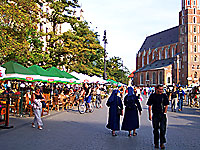
Grand Square On Line
Krakow’s
central Rynek Glowny grand square has
been turned into a zone of free wireless internet
access, Poland’s first and one of world’s few to
date. All you need to get connected is a laptop with
a PCMCIA card or an external WiFi device. Once
online, there appears a welcome window with ads that
are source of revenue for two firms, Xylab and DRQ,
providing the service.
Taking a Look Under the Rynek Glowny Sq.
Krakow’s huge central Rynek Glowny grand square have
been partly turned into a site of archeological
excavations. Archeologists have got an opportunity
to explore the plaza prior to next year’s long
overdue thorough renovation of its paving. The Rynek
Glowny, whose vastness surpassed any square in other
cities of medieval Europe, used to have many
buildings amid it and most of them have not
survived. The ancient Krakow forum still remains the
city’s hub.
Soldiers to Police Krakow
Under new scheme to boost
safety in Polish cities the Krakow police
has been reinforced with 98 conscripts who
volunteered to
walk the streets rather than join the
army. They have undergone basic police training and
will stay on the beat for a year. Military service
is mandatory in
Poland but nowadays number of available
conscripts far surpasses needs of the armed forces.
More of the World’s Heritage in the Krakow Region
UNESCO has added further four sites in the
Krakow area to its prestigious list of the world’s
culture and nature heritage. Of south Poland’s six
wooden village churches newly entered in the
register on July 3 those of Debno Podhalanskie,
Lipnica Murowana, Sekowa and Binarowa are situated
in the
Malopolska Province whose capital city is
Krakow. They all date back to the 15th century. The
region’s other
World Heritage sites are Krakow’s entire
Old Town historic district, the
Wieliczka Salt Mine,
Auschwitz, and
Kalwaria Zebrzydowska’s Calvary sanctuary.
58 Tests HIV-Positive in the Province
Seven more inhabitants of the
Malopolska province, of which Krakow is
the largest city and capital, has tested
HIV-positive in the first half of 2003–freshly
released
health data reveal. It adds to the total
of 65 cases that occurred in years 1989 to 2002, in
the province’s population of 3.2 million. Since 14
of the infected with the virus developed AIDS and
died to date, now the number of known HIV-positive
patients amounts to 58, or one in roughly 55,000
inhabitants. Last year nine new instances of HIV
infection occurred throughout the entire province.
Krakow’s Police Have Got State-of-the-art Command &
Control
The state police has introduced a $11-million modern
system of command and control in Krakow. Its heart
is a state-of-the-art operations room with digital
wall
map of the entire city that traces every
move of 60 new patrol cars equipped with computers
with access to central databases. The operations are
integrated with number 112 police call center and
remote-TV 24/7-surveillance system. The latter now
consists of four cameras at
Krakow’s central Rynek Glowny grand square
but soon another 20 are to be installed throughout
the city in vital points.
New Immigration Law Makes It Easier for Aliens
Illegal aliens in Krakow–or anyplace in this
country–may take advantage of abolition if they
apply to the province’s ‘wojewoda’ (prefect) between
September 1 and December 31. Those who have lived in
Poland at least since the end of 1996 are
entitled to yearly, renewable
residence permit provided they own or
rent a dwelling and have either job or
proven resources to support themselves and the
family. Newly introduced law allows also for
‘tolerated residence’ of foreigners who are unfit
for refugee status but cannot be returned to their
native countries for humanitarian reasons. A
wojewoda grants the ‘tolerated resident’ a right to
stay in the country for limited time that can be
extended if necessary, and such person don’t need
any work permits and is eligible for social
security, universal
health care, and state-funded
education.
Krakow’s Triennial Lives Up to Expectations
Some 300 artists from 52 countries have sent their
entries for Krakow’s International Graphic Art
Triennial 2003. They make the central show in the
Bunkier Sztuki and
Palac Sztuki adjacent
galleries
at Szczepanski Pl. that opens September 19. On top
of it come 50-plus other exhibitions in various
venues all over the city, from the National Museum’s
main hall (Grand Prix 2000 winner, Poland’s Tomasz
Struk, since Sep. 19) to Austrian Consulate
(Austria’s young artists since Sep. 20). The Krakow
triennial has been for decades one of the world’s
prime festivals of graphic arts, from woodcuts to
serigraphy to digital.
Old Tunes, New Fiddle
The moving spirit behind Krakow’s Beethoven Easter
Festival, Elzbieta Penderecka, has launched a
private association to organize the next year’s
edition of the city’s premier classical-music
event, parting ways with the erstwhile
patron, municipal Festival Bureau. The new body has
its seat in Krakow but Mrs. Penederecka, privately
wife of renowned composer Krzysztof Penderecki,
hasn’t ruled out moving the
festival elsewhere altogether or in part.
Krakow’s mayor, Professor Majchrowski, says the
municipality
claims no rights to the musical event it has
underwritten since the very beginning in 1996.
Krakow’s Hospital at the Forefront against Cancer
The
Krakow university hospital’s 1st Surgery
Clinic has got a brand-new, state-of-the-art tool to
fight cancer. The $500,000 Mobetron machine destroys
micro metastases round the tumor that are otherwise
left behind after the surgery. Krakow is just ninth
place in the world, and the only one outside the USA
and Japan that can boast such device.
The Oldest and Still Growing
Over 38,500 students have enrolled at Krakow’s
639-year-old Jagiellonian University, Poland’s
oldest and most respected, this academic year
2003/2004 that began on October 1st, an increase of
seven percent. New studies added to the university’s
curriculum include applied economics, international
economics, Ukrainian studies, applied computer
science, biophysics and molecular biophysics.
Krakow Has Got Brand-new School
Yet another
institution of higher education has
joined vast array of Krakow’s university-level
education establishments this year. On October 1 the
Jozef Tischner Higher European School, named after
Krakow’s late philosopher-priest, entered its first
year of teaching. For starters its curriculum
consists of sociology, international relations,
European integration, public relations, and business
communication. It has managed to enroll 440 freshmen
to date.
Krakow to Tap EU Money, Fingers Crossed
Krakow’s municipality has applied for
around 46.5 millions euro next year in subsidies
from the EU assistance funds to finance the city’s
various projects, from
transportation to tourist promotion. Yet
only a fraction of the sum can be reasonably hoped
for since for beginning just euro 30 millions or so
will be made available this time to all
municipalities in the
Malopolska Province, whose capital city
and by far the biggest subdivision is Krakow. Now
the proposed projects are subject to evaluation by
the provincial government and those authorized will
come under still closer scrutiny of the Brussels
bureaucracy. Polish government has earmarked euro
180 millions of the EU money for the Malopolska
province over the next three years.
You Are Watched
Seventeen new surveillance TV cameras have been
installed in the busiest spots of Krakow’s downtown,
the bulk in places often frequented by foreign
visitors, in addition to the four that already
surveyed the
central Rynek Glowny grand square. They
all relay images in real time to five district
police stations and the operations room in the
police city headquarters via an integrated computer
system that also enables to control their movements.
The cameras give resolution high enough to read
newsprint 20-30 meters away. They cost $3,750
apiece, and the whole system $500,000.
Krakow’s Main Musical Event Goes Warsaw
Organizers of the Beethoven Easter Festival have
announced they are moving it next year from
Krakow to Warsaw, Poland’s capital city.
To make up for the loss of one of the city’s
signature
cultural events, Krakow’s municipality
contemplates some other classical
music festival in the early springtime,
though no details have been disclosed to date. Since
1996 the Beethoven Easter Festival took place in
Krakow annually, over the week or two preceding
Easter
and on the holiday itself.
Museum Shows Sweet Home of the Past
Brand-new
museum of period interiors has opened in
The Hippolits’ House (Kamienica Hippolitow) at 3
Mariacki Pl., next to the basilica of the Virgin
Mary’s. The branch of the City of Krakow Historical
Museum recreates the
dwelling of a Krakow burgher family from
the 17th through the 19th century. Genuine period
furniture, works of
art, bibelots, and various homey
artifacts fill the well-preserved residence of The
Hippolits patrician family, with rooms rich in
architectural details, elaborate stuccos and
graceful frescos.
Conservation vs. Cuts
Though
Krakow’s prime landmarks are now well
preserved, 234 of the city’s historical buildings
urgently need renovation till 2010, says document
released jointly by the city’s conservation
authorities. The total cost of over $100
million is manageable if the government current
subsidies to the tune of roughly $7,500,000 a year
will stand. Unfortunately, as Poland’s crippling
budget deficit looms large in the country’s politics
the parliament seems set on cuts across the board.
Krakow’s Downtown To Get a New Mall
Construction of 112,000-square-meter Galeria Kazimierz
shopping and
entertainment center has started in
downtown Krakow on the six-hectare site of
125-year-old meat-processing plant that at long last
has moved uptown a couple of years ago. Developer,
the Globe Trade Center corporation, promises the
mall with 160 shops, a 3,000-sq-m deli, and a
ten-theater
cinema multiplex will open in the first
quarter of 2005. The 70-million-euro project fuses
together brand-new architecture and relic industrial
buildings of the former plant.
Say Sayonara
Construction of 360-square-meter Japanese Language
School started by the
Manggha Center for Japanese Art and Technology
at 26 Konopnickiej street, on the Wisla river bank
just opposite the
Wawel Royal Castle. Japan’s rail workers
trade union donated $200,000 for the building while
the Japanese government has given $400,000 for
state-of-the-art equipment.
Krakow Has Attracted 5.5 Million Visitors in 2003
Some 1.8 million tourists visited Krakow this summer,
and roughly 240,000 of them came from abroad. In the
whole year 2003 about 5.5 million
visitors are expected to show up in the
city that is Poland’s top attraction, and more than
million to stay overnight. Among the foreigners the
largest contingent, 12.1 percent, form Germans
followed by Americans (10.5 percent), Britons (9.7
percent), Frenchmen (8.1 percent) and Italians (8.1
percent), Israelis (8 percent), and Norwegians (6.5
percent). The busiest months are June and August,
while the quietest prove January and February. An
average tourist spends some $55 while in Krakow (a
foreigner, $255 or so) and the windfall for the city
totals roughly $450 million a year.
Comfy Kiev Connection
New comfy express
train service has been launched between
Krakow and Kiev, the capital city of Ukraine. On a
16-hour journey in brand-new air-conditioned
sleeping cars with facilities for the
disabled the passengers can enjoy DVD and
radio, and take shower. The night express runs three
times a week either direction, and a one-way ticket
is an equivalent of $40 first class and $35 second
class.
City Bus/Tram Ticket Is $0.6 in 2004
Krakow’s municipality has resolved to raise fares at
the city’s buses and streetcars since January 1,
2004. New price of a one-way ticket is 2.4 zloty (an
equivalent of roughly $0.6). An hourly ticket
allowing for changing lines is to be 3 zloty, while
the cost of a 24-hour unlimited-travel pass for all
municipal buses and streetcars has been set at ten
zloty, it’s 48-hour equivalent at 18 zloty, and a
72-hour one at 24 zloty. A monthly pass is 90
zloty.
And Public Toilet Is $0.25
For the first time since 1994
Krakow’s municipality
has increased fees at the city’s 29 public lavatories
it manages. From January 1, 2004, a use of urinal
entails cost of 0.5 zloty, while the privacy of a
cubicle has been valued at one zloty (i.e. an
equivalent of $0.25 or so). The municipal yearly
outlays for maintenance of the public conveniences
total an equivalent of about $375,000.
Krakow’s Authorities Hope to Lure Cheap Carriers And
Boost Tourism
Krakow’s municipality, the
Malopolska Province’s government, and a
property-management agency of Poland’s Ministry of
Defense have launched together a joint-stock
company, Krakowski Port Lotniczy (The
Krakow
Airport), with a single purpose to bring
cheap, no-frills airlines to the city. In 5-8 months
the new firm is to build a passenger terminal near
Balice international airport in order to use its
landing strip. Krakow’s officials behind the project
expect the first carrier to start regular services
this June or September. Without naming names, they
revealed that six interested airlines have already
approached them about signing up.
|