See the maps:
Map of the Old Town Historic District
(73k)
Krakow's
historic area
in a close-up: prime
landmarks,
distinct
streets
and
squares
with their names writ large.
Map of Krakow's Kazimierz historic district (176k)
City of Krakow map
(165k)
Krakow districts, suburbs, city limits, arteries,
streets,
parks,
rivers and reservoirs.
Driving Car in Krakow
(123)
Pedestrian precinct and streets off limits to
cars in
downtown Krakow, parking zones and parking lots in
the city center.
Map of the Main Roads in Krakow
(49k)
Main
routes
to, through, and out of Krakow.
Poland Map
(91k)
Poland's
national borders, neighbors,
main roads,
cities, principal
airports,
mountain ranges, rivers and lakes.
Large Poland Map
(190k)
Poland's
national borders, neighbors,
main roads,
cities, principal
airports,
mountain ranges, rivers and lakes - but everything much larger.
Malopolska Province Map
(33k)
Map of
the province
(one of Poland's 16) of which Krakow is capital, with the
boundaries of the counties and their chief cities. Plus
the province's essential data.
|
|
Krakow: General Data:
Geography,
Weather,
Local Government,
Economy,
History,
Culture,
Money,
Environment,
Wildlife,
Malopolska
Province,
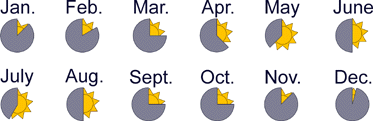
Krakow enjoys a temperate climate with features of both
European marine west coast and more severe continental
conditions of Eastern Europe. "Days are longest in June,
hottest in July, and most beautiful in August” – an old
Polish poem says. On the other hand, Krakow’s perfect
springs fill the city with sweet-smelling blossoms from mid
April through May. While the famed Polish “golden autumns”
bring dry and warm weather amid rich colors of dying leaves
from mid September to mid October or so. And Christmas in
Krakow is positively white.
More on weather in Krakow
|

Krakow is the capital of the
Malopolska
wojewodztwo,
one of the most prominent provinces among the country’s
16. As in the case of other major Polish cities,
Krakow’s local government is county and commune rolled
into one municipality. The legislative City Council
numbers 43 members, voted in every four years in a
popular ballot by way of proportional representation.
The executive powers lie with Krakow's mayor, called the
president of the city (prezydent miasta), elected
by the citizens for a four-year tenure.
More on Krakow's local government
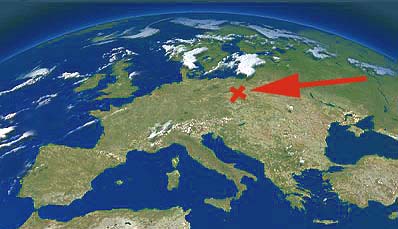
Krakow lies in the very center of continental Europe,
i.e. roughly halfway between the westernmost Lisbon in
Portugal and the easternmost Urals, and equidistant from
the Mediterranean and the arctic Barents Sea.
Krakow,
with its 750,000 or so citizens,
is Poland’s second largest city and the unquestioned
metropolis of its southern half. The city’s area of
326.8 sq. kilometers (0.1 percent of
Poland’s
territory) spreads on both banks of the Vistula river,
some 219 meters above the sea level.
More on Krakow geography
The high-tech gets high profile by day in Krakow. The
city boasts Poland’s first and third most-visited
internet portals. It can boasts a special economic zone
(Krakow Technological Park, meant for major high-tech
investments) with the Motorola’s European R&D center, 4
enterprise incubators, 3 commercial-fair grounds, 7
higher economics schools.
More on the Krakow economy
Culture has always been all-important in Krakow.
More on the culture in Krakow
Poland's currency is zloty (PLN). It is divided into one
hundred smaller units called grosz (abbreviation gr).
More on the money in Krakow |
There is a number of wildlife preserves within the city limits, established
mostly for the protection of endangered flora species. The 21.5 sq. km
Ojcow National Park lies just 24 km northwest of Krakow. Larger
woodlands, the 27,000-acre Puszcza Niepolomicka, stretch some 25 km east from
the city center. The forest bison, zubr, reintroduced to the area in 1936, roam
that remnant of Poland’s primeval forests among its rich fauna. While stray deer
or roe, to say nothing of fox, can be seen occasionally anywhere in Krakow’s
outskirts.
More on wildlife in Krakow
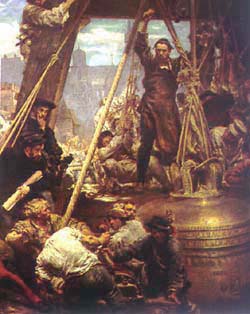
In 1000 Krakow got its own bishop, and in 1038 the city became Poland’s capital.
Krakow’s Golden Age came by the end of the 15th century when it was the thriving
metropolis of a vast and prosperous kingdom stretching from the Black Sea to the
Baltic Sea.
More
on Krakow's history
In the past ten years every part of Krakow managed to meet the air-quality
standards. For instance, fine particulate matter stayed within the range between
46 percent and 78 percent of the acceptable concentration most of the year. And the sulfur dioxide, responsible
for acid rain, stayed in Krakow’s central
Grand Square at half the
level UNESCO allows for its
World Heritage Sites.
More
on the ecology in Krakow
|
|
Basic Krakow info for visitors coming to Krakow
Poland
nation, geography, climate, wildlife, visitors,
currency.
Malopolska Province
Krakow's Transport
How to move about the city.
Travel to Krakow
In the proximity of Krakow
Krakow is Poland's tourist mecca, and also a gateway to
many other must-see sites in the region.
Dining guide
Lodgings guide
Real estate in Krakow
|

