|
The ultimate Krakow guidebook.
-
attractions
-
landmarks
-
museums
-
restaurants
-
hotels
-
entertainment
-
travel
|
|
Krakow Theater
Krakow features prominently on the theater map of
Europe. Its legendary National Stary
Theater counts among the continent’s best companies
of players. As the rest of the city's repertory
theaters it runs several playhouses of varied
capacity.
More on Krakow theaters
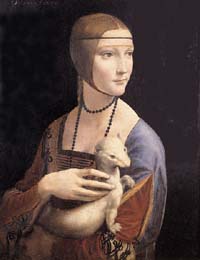
Museums in Krakow
Krakow boasts the best collections in Poland, and some
of its treasures are the envy of every museum in the
world.
More on Krakow museums
|
|
|
Thanks to its maximum
seating capacity of 18,000 or so, the Krakow Arena easily surpasses in size any other indoor
stadium in Poland
and ranks among Europe’s largest venues of this type. It also beats other domes
on such counts as novelty or versatility.
Go to
the Krakow Arena
ICE stands for International Conferencing and Entertainment.
Its main Auditorium Hall can
seat 2,000 people. The seating capacity of two other,
smaller halls is 600 (Theater) and 300 (Chamber Hall)
respectively. Plus there is so called Conference Hall
Complex of 11 rooms seating 35 people each.
Go
to the ICE Krakow congress center
The Manggha Center of Japanese Art and Technology
Krakow’s outpost of the Japanese creativity and
ingenuity is the biggest such institution in the whole
Central and Eastern Europe. The Center’s wave-shaped
building on the bank of the Vistula river just opposite
the
Wawel Hill houses the Japanese treasures amassed by
a wealthy Polish connoisseur, Feliks “Manggha”
Jasienski, by the end of the 19th c.
The Manggha Center organizes various temporary
exhibitions, concerts, presentations, etc., pertaining
mostly but not exclusively to Japan’s national heritage
or its present-day achievements.
Go to the Manggha Center
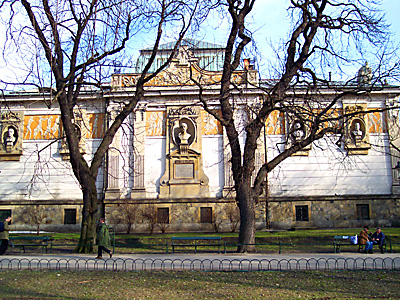
Palace of Arts
The Palace of Arts was erected in 1901 for the Society
of Fine Arts Friends. Krakow's first Art Nouveau
building has remained one of the most prestigious
exhibition venues in the city. Once mostly works of
established value can be seen here yet nowadays purely
commercial events also happen.
Go to the Palace of Arts
Bunker of Arts
A
modern exhibition hall of gray concrete amid ancient
landmarks of Krakow’s historic
Old Town
district, has been dubbed “the bunker” before long. The
contemptuous label was embraced by its managers who
turned their ‘Bunker of Arts - The Contemporary Art
Gallery’ into a stronghold of the avant-garde.
Go to the Bunker of Arts
Krakow Opera House
The
complex of the Opera House in Krakow, built in
2008, contains three
theaters, foyer that doubles as an exhibition and/or
lecture hall, box offices, and a restaurant. It's the
city's main venue for opera, operetta, and ballet
shows.
Go to the Opera House in Krakow
Conference Facilities in Krakow
The
city’s rich cultural and social milieu, beauty of its
central historical district,
accessibility,
good hotels, vibrant
club scene, and profusion of
restaurants
and cafes makes Krakow superb
location for congresses and conferences.
|
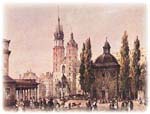
Grand Square
Krakow's
central square,
the largest of medieval European cities, is arguably one
of the world’s most beautiful plazas. It boasts a
plethora of landmarks and myriad restaurants, clubs, and
cafes.
Go to the Grand Square
Sanctuary of Divine Mercy
Krakow's
modern Sanctuary of Divine Mercy in Lagiewniki district
has become one of the world's top destinations for the
Catholic pilgrims.
Go to the Sanctuary of Divine Mercy in Krakow International Culture
Center
Krakow's
International Culture Center was
founded in 1990 to facilitate the intercourse between
peoples of different cultures. Its main field of
interest is the cultural heritage of the Central Europe.
The center engages in a wide range of activities: from
research to education to art presentation to information
services.
Go
to the International Culture Center
Center for Jewish Culture
The Center for Jewish Culture, set up amid
Krakow’s former
Kazimierz Jewish Quarter
in 1993, protects the heritage of Poland’s Jews,
popularizes it, and conducts research. Its site in the
former 19th-century prayer house at 17 Meiselsa street
is the venue of numerous shows, recitals, conferences
and other cultural and scholarly activities.
Go to the Center of Jewish Culture
Villa Decius
Krakow’s Villa Decius, the Renaissance mansion built c.
1530 for a powerful secretary of
King Sigismund I the Old,
is one of Poland’s best palatial suburban residences.
Now it shines again after a thorough renovation as
Krakow’s home to the European Academy.
Go to the Villa Decius
Piwnica Pod Baranami
Cabaret Company
It might have happened in Krakow alone that a
cabaret
was elevated to the rank and authority of a national
institution. Sure, since its birth in 1956 the
Piwnica Pod Baranami in the cellar of the Pod
Baranami
palace at 27
Grand Square
has been a very special brand of high-brow
entertainment: a literary variety show with poetic songs
and mostly pure-nonsense humor (both being its hallmarks
till now). And the cabaret company of Piwnica Pod
Baranami has proved over the past four decades a
magnet for outstanding personalities of at least three
generations.
Go to the Pod Baranami cabaret |