|
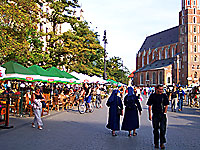
The People of
Krakow
Officially, the citizenry of the city of Krakow is is put at
some 760,000 but the figure leaves out thousands of actual
residents who don't bother to register as such, illegal
immigrants, and about 100,000 students with permanent homes
elsewhere. At the same time the
population of entire metropolitan area, i.e. the Krakow
proper together with its outer suburbs and satellite towns,
totals some 1.5 million people. And the headcount within the
100-kilometer (62-mile) radius approaches nine million.
The city’s residents are solidly Polish. Nevertheless
several thousand foreigners live more or less permanently
here. In Poland the denizens of Krakow enjoy a reputation of
meticulous and frugal folk, a bit reserved but life-loving.
Krakow's population is swollen, notably in summer, by over
eight million visitors a year on tourist or business trips.
Sex and age
in Krakow
In Krakow there are slightly more women,
400,000-plus among the registered citizens, than men.
The average age of the city dwellers’ is 37.5 years, with
over 60 percent of the population being under 45, whereas
the number of elders of 65 or more amounts to 14.9 percent.
Currently the city has negative birth rate of –0.04
percent.
On average a male resident of Krakow lives 73.5 years
compared to 80.6 years for a female.
Education and labor market in Krakow
About twenty percent of Krakow residents can boast an
academic degree of MA or an equivalent, while 180,000-plus
students attend the city’s 21
institutions of higher education.
The unemployment rate in Krakow ranks among the lowest in
Poland and it has slipped below three percent in 2007 to
remain level thereafter, more or less.
Satisfaction
factor.
Residents of
Krakow generally enjoy living in the city. The Urban Audit
Perception Survey, conducted in November 2006 within the
Flash-Eurobarometer project of the European Union, has found
that 97 percent of the Krakow’s population are satisfied to
live here. Only residents of Groningen in The Netherlands
voiced such high level of satisfaction with their place /by
comparison the ratio of contented citizens was 60 percent or
so in Athens and Naples, nearly 80 percent in London, and
some 85 percent in Lisbon – to name just few of the 75
surveyed cities in the EU, Croatia, and Turkey/.
|