|
Krakow's World-class Attraction, the Salt Mine of Wieliczka
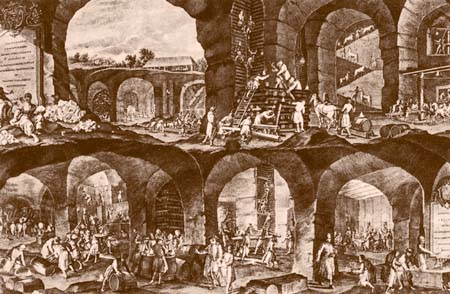
One traveled Frenchman observed in the 18th century that
Krakow's Wieliczka salt mine was no less magnificent than
the Egyptian pyramids. Millions of visitors, the crowned
heads and such celebrities as Goethe and Sarah Bemhardt
among them, have appeared to share his enthusiasm when
exploring the subterranean world of labyrinthine passages,
giant caverns, underground lakes and chapels with sculptures
in the crystalline salt and rich ornamentation carved in the
salt rock. They have also marveled at the ingenuity of the
ancient mining equipment in the Wieliczka salt mine. And the
unique acoustics of the place have made hearing music here
an exceptional experience.
The Wieliczka Salt Mine, nowadays practically on the
southeast outskirts of
Krakow,
has been worked for 900 years. It used to be one of the
world's biggest and most profitable industrial
establishments when common salt was commercially a medieval
equivalent of today's oil. Always a magnet, since the
mid-18th century Krakow's Wieliczka salt mine has become
increasingly a tourist attraction in the first place. Today
visitors walk underground for about 2,000 m in the oldest
part of the salt mine and see its subterranean museum, which
takes three hours or so.
Nine centuries of mining in Wieliczka produced a total of
some 200 kilometers of passages as well as 2,040 caverns of
varied size. The tourist route starts 64 m deep, includes
twenty chambers, and ends 135 m below the earth surface,
where the world's biggest museum of mining is located with
the unique centuries-old equipment among its exhibits.
Occasionally concerts and other events take place in the
Wieliczka mine’s biggest chambers.
There is a sanatorium for those suffering from asthma and
allergy situated 135 meters deep underground in the
Wieliczka Salt Mine.
UNESCO has entered the Wieliczka Salt Mine in its
World Heritage Register in 1978. In June 2013 the
800-year-old Bochnia Salt Mine, 50 kilometers east of
Krakow, has been added, the two World Heritage Sites to be
listed together as The Royal Salt Mines of Wieliczka and
Bochnia. .
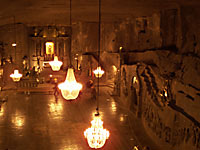 |
Chapel of Saint Kinga,
the largest among underground chapels
in the Wieliczka Salt mine, is actually a sizable
subterranean church carved in rock salt and
embellished with salty sculptures and bas-reliefs. |
Wieliczka Salt Mine is
accessible all year round.
Except it's closed on January 1, Easter Sunday, November 1,
and Christmastide (i.e. December 24-25). April through
October visitors may see the Wieliczka Salt Mine between
7:30 a.m. and 7:30 p.m., and November through March from 8
a.m. till 5 p.m.
On Easter Saturday and December 31st closing time is 3,30 pm
and 4 pm respectively.
All visitors need to join a guided tour.
Groups should book the tour in advance by phone at (+48)
122787302 or fax at (+48) 122787333 or email at
turystyka@kopalnia.pl
English tours for individual visitors take place every
thirty minutes between 8:30 a.m. and 6 p.m. In June and in
September they start at 9 a.m., 10 a.m., 11:30 a.m., half
past noon, 1:45 p.m., 3 p.m., 4 p.m., and 5 p.m. In October
through May the English tours are available at 10 a.m., 11
a.m., 11:30 a.m., half past noon, 1:45 p.m., 3 p.m., and 5
p.m.
German tours for individual
visitors start in July through September at
10:45 a.m., 2:15 p.m., and 4 p.m. In October through June
the German tours take place at
10:45 a.m. and 4 p.m.
Nightly tours take roughly 1h30, and they are available
via advance booking by phone at (+48) 122787302
Note:
Temperature in the Wieliczka Salt Mine stays uniform 15
degrees Celsius, i.e. 59 Fahrenheit, round the year.
Travel
Salt Mine in Wieliczka is situated some ten kilometers from
the center of Krakow. One may get there easily by car or
taxi. Also, you can take a commuter train from the city's
central Krakow Glowny rail station, a bus, or one of
numerous minibuses that cruise Krakow's streets.
Note:
Bus 304 from Krakow to Wieliczka leaves
from Dworzec Glowny Zachod stop by Galeria Krakowska
shopping mall at Pawia street. Visitors to the
salt mine should get off at Wieliczka Kopalnia stop.
Yellow buses operated by Mobilis company run every 20
minutes or so. The fare is an equivalent of under one euro.
Tickets
to the Wieliczka Salt Mine are available at the entrance in
the Szyb Danilowicza pithead building at 10 Danilowicza
street.
Regular ticket for Polish tour
costs 59 PLN
(Polish zloty)
in July and August, otherwise 55 PLN.
Reduced-rate ticket for Polish tour (e.g.
schoolchildren) costs 43 zlotys
in July and August, otherwise 39 PLN.
Family ticket for Polish tour (2 adults plus 2
minors) costs 161 zlotys
in July and August, otherwise 149 PLN.
Regular ticket for a guided tour in a foreign language
costs 89 PLN
(Polish zloty)
in July and August, otherwise 84 PLN.
Reduced-rate ticket for a guided tour in a foreign language
costs 69 zlotys
in July and August, otherwise 64 PLN.
Family ticket for English or German tour (2
adults plus 2 minors) costs 247 zlotys
in July and August, otherwise 232 PLN.
Tours of the Wieliczka Salt Mine for the
disabled.
The handicapped in wheelchairs can tour the most popular parts
of the Wieliczka Salt Mine, in that number two of its
subterranean lakes, underground churches of St. Kunegunde’s
and of the Cross, the Dwarfs’ Cave, etc. It's advisable to
arrange the visit in advance through a phone call put at
(+48) 122787302 or fax at (+48) 122787333.
Other UNESCO World Heritage sites in Krakow and the Malopolska Province
Krakow's Old Town historic district
Auschwitz concentration camp
The Calvary sanctuary of Kalwaria Zebrzydowska
Malopolska's wooden churches
|
Krakow
Poland's prime tourist attraction and a must in
Central Europe boasts numerous world-class monuments, charming
vistas, delightful atmosphere, and the best restaurants.
In the proximity
of Krakow
Krakow is Poland's tourist mecca, and also a gateway to
many other must-see sites in the region.
You may choose one of over 25,000 beds in Krakow.
Krakow Hostels
Holiday Apartments in Krakow
A guide to Krakow's Best Restaurants
Krakow is Poland’s mecca of gourmets thanks to its many
excellent restaurants.
Krakow tours and day trips
Travel to Krakow
Over seven
million visitors show up in Krakow every year. Many
arrive by air,
but most take advantage of the fact that Krakow lies at a major
European road and
rail
junction.
Krakow's Transport
How to move about the city.
|