|
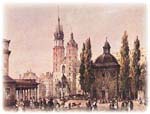
Grand Square
Krakow's
central square,
the largest of medieval European cities, is arguably one
of the world’s most beautiful plazas. It boasts a
plethora of landmarks and myriad restaurants, clubs, and
cafes.
Go to the Grand Square
The Wieliczka Salt
Mine
Millions of visitors, the crowned heads and such
celebrities as Goethe and Sarah Bernhardt among them,
have enthused over that subterranean world of
labyrinthine passages, giant caverns, underground lakes
and chapels with sculptures in the crystalline salt and
rich ornamentation carved in the salt rock. The last 900
years, when the Wieliczka Salt Mine has been worked,
produced 200 kilometers of passages as well as 2,040
caverns of varied size.
Go
to the Wieliczka Salt Mine
Prettiest Leonardo da
Vinci
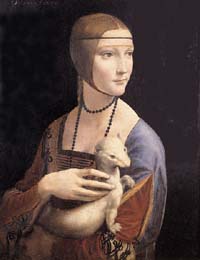
Krakow is one of just six
places in the world that can boast a painting by
Leonardo da Vinci. And of his three female portraits
Krakow’s Lady with an ermine is arguably the most
beautiful.
More on Krakow's Leonardo
Kanonicza Street
Scenic Kanonicza Street used to constitute the last and
most glorious part of the
Royal Road,
Krakow’s ceremonial route leading from the main city
gate to the
central square
to the
Royal Castle.
Lined with stately, mostly Renaissance houses, it is
arguably one of Europe’s finest streets.
Go to the Kanonicza Street
Auschwitz
The site of the Nazi notorious Auschwitz death camp is an
hour’s drive from Krakow. About one million men, women
and children of many nations perished here between June
1941 and January 1945.
Go to Auschwitz 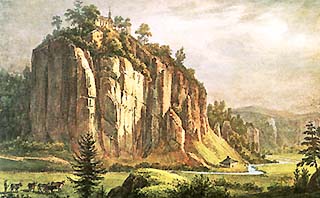
Ojcow National Park
With its mere 21.5 sq. km it may be the smallest of
Poland’s twenty national parks, but the Ojcow National
Park ranks among the most attractive recreational areas
in Europe, and it is just a 15 minutes’ drive–i.e. 24
km–northwest of Krakow.
Go to the Ojcow National Park
Window of awe
The
world’s arguably greatest modern stained-glass window,
the powerful depiction of the Creation, shines above the
entrance to
the basilica of St. Francis’
since 1900.
More on the 'Creation' window
|
Wawel Hill
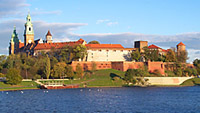
Mecca of every Pole and a must for foreign tourists, the Wawel Hill is a
microcosm of Polish history and culture. From the 11th century on
Poland's monarchs took up their residence here in the Royal Castle. And they were both crowned and
buried here in the Wawel Cathedral.
The place overflows with art treasures, architectural beauties, relics of the
past and curiosities. It is also full of glory, magic, history and fable.
Go to the Wawel Hill
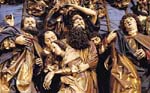
World's greatest medieval sculpture
The 42-foot-high and
36-foot-wide Veit Stoss' magnum opus is the largest Gothic sculpture in the
world. It consists of 200 fine limewood sculptures treated with color and gold
foil. The central part, with huge lifelike statues of the saints, depicts
dramatically the Virgin Mary's Quietus among the Apostles.
More
on Stoss' altarpiece
Collegium Maius of the Krakow University
The Grand College, or Collegium Maius, the
oldest college of Poland's oldest and best
university, houses the University Museum now. It was
rebuilt by the end of the 15th century as a splendid
late-Gothic edifice around a vast courtyard with
surrounding arcades and a well of 1517 in the
center. Professors lived and worked upstairs, while
lecturing downstairs. In the 1490s they had
Copernicus among their students.
More on the Collegium Maius
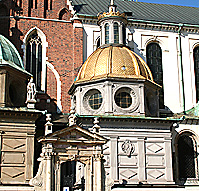
Renaissance pearl
The gold-plated dome of the Sigismund Chapel crowns
the best example of Renaissance art and architecture
with no match without Italy and few equals within.
More on the Sigismund Chapel
Kazimierz Town
Now in Krakow's downtown, the ancient city of Kazimierz
used to be its medieval rival. The area contains many
landmarks and the former
Kazimierz Jewish Quarter,
one of the main centers of Diaspora in the past.
Go to Krakow's Kazimierz District
Signal trump
Every full hour a golden trumpet shows above Krakow’s
central
Grand Square
in the west window just below the spire of the higher,
municipal tower of the
Basilica of the Virgin Mary's.
More on Krakow's signal
|