Fine arts in
Krakow
The visual arts have always been Krakow’s forte. Over centuries the city
bred outstanding painters and sculptors or lured them to settle
within its walls.
The medieval art in Krakow
A number of first-rate artists worked in Krakow throughout the
Middle Ages. Even though their names are largely long forgotten
nowadays, their masterpieces often grace the city’s many
churches
to date, while most have been transferred to museums. And in the late
15th century Krakow was home to the world’s greatest sculptor of the
Gothic, Veit Stoss (Wit Stwosz). He lived
and worked here for nearly 20 years that proved his best, of which
dozen, i.e. 1477–1489, he devoted to create the
magnificent 42-foot-high altarpiece in the
basilica of the Virgin Mary’s.
The Renaissance art of Poland's golden age.
King Sigismund I
(1506-1548)
ruled over one of Europe’s vastest and mightiest realms of the time,
so he could afford to bring excellent Italian artists, mostly
sculptors and architects, alongside his ambitious Sforza wife to
turn his Krakow’s residence, the Wawel Royal
Castle, into an exemplary Renaissance palace. They settled in
Poland’s then capital to work for the monarch as well as other
patrons. And the Wawel Cathedral’s
golden-domed Sigismund Chapel
stands out as their collective work of genius. With time native
artists, such as Jan Michalowicz, matched the Italians they had
learned from. Sigismund I also employed Albrecht Durer’s younger
brother, Hans, as the court painter. King’s son and heir, Sigismund
August (1548-1572), famous among the European royalty for his
collector’s passion, amassed a matchless
collection of Flemish tapestries. He also brought fabulous
sculptor and architect Santi Gucci from Florence to Krakow. Yet
Krakow’s best masterpiece of the Renaissance arrived in the city in
1876 when Prince Czartoryski brought Leonardo da
Vinci’s wonderful ‘Lady with an Ermine’ to his museum.
The baroque art of Krakow.
Krakow is full of spectacular Baroque
churches
and palaces of the 17th c. and 18th c. Notably the former brim over
with exquisite period art. Among painters Thomas Dolabella (Della
Bella) stood out–the Venice-educated artist had already secured
commissions from the Doges’ Palace when in 1598 Polish king lured
him to Krakow. Here he lived the next 50 years painting hundreds of
portraits and large-scale realistic scenes for the monarch and the
church. His immense works are most readily accessible (despite poor
exposition) in the Dominican basilica and the Franciscan basilica,
facing one another in Krakow’s Old Town
historic district. At the turn of the 18th c. also Italian-born
Balthasar Fontana adorned some Krakow prestigious interiors with
excellent decorations, elaborate and rich, most adeptly sculptured
in stucco.
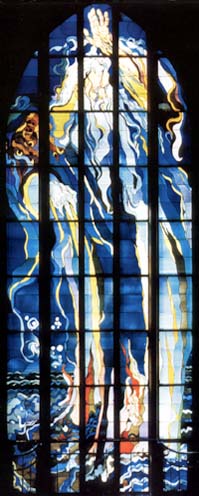
The powerful depiction of the
Creation has shone above the entrance to Krakow's
basilica of St. Francis’ since the turn of the last century. The
design of Krakow’s artistic and literary genius Stanislaw Wyspianski
(1869-1907), entitled ‘Become!’
but known also as ‘Our Father’, tops his other
outstanding works in the same imposing 13th-century Romanesque temple.
The 19th-century Krakow's art
In the first half of the 19th century Krakow was an artistic
backwater, four Thordvaldsen’s works in its
Wawel Cathedral notwithstanding. Small wonder one of the
country’s greatest talents ever remained largely unnoticed. His
contemporaries knew Piotr Michalowski (1800-1855) as a wealthy
aristocrat, skillful administrator, laudable civil servant of the
Grand Duchy of Krakow, and amateur painter who once indulged in
four-year Paris studies in ateliers of famed French artists. It took
two generations to recognize in him an outstanding European painter
of the romantic era.
In the second half of the same century Krakow’s Jan Matejko
(1838-1893) gained immediate international renown when he was
awarded the golden medal of the 1865 Paris Salon, his first in an
array of similar trophies, and publicly praised by the likes of
Gautier. His giant and meticulously enacted, almost cinematic
renderings of the most dramatic moments in Poland’s history
dominated the Krakow art scene till the 1890s.
Art of the turn of the-20th century
In the 1890s Krakow saw an eruption of talent, when an awesome gang
of painters, sculptors, poets and writers formed the Young Poland
movement, the native branch of the Art Nouveau, to revolutionized
the Polish art. Among them Stanislaw Wyspianski (1869-1907) stood
out as towering artistic and literary genius. He painted remarkable
landscapes and striking portraits, designed inventive layouts and
furniture as well as visionary architecture and interiors, wrote
drama masterpieces and profuse poetry, and fused stagecraft,
literature, music, scenery and costumes into total theater
experience. Yet most impressive–and comprehensible to foreigners–are
his majestic stained-glass windows and
frescoes such as those realized in Krakow’s
church of St Francis’.
The 20th-century art
In the first half of the past century some best Krakow painters
shuttled between the native city and France where they were part to
the Paris artistic scene. No wonder their output often matched
closely the newest fads. Those of the younger ones who settled on
the Seine for good formed the core of the Ecole de Paris
group. Others returned to Krakow to start the ‘kolorysci’
(colorists) school that was to dominate the Polish painting well
into the 1960s when the ‘Grupa Krakowska’ (Krakow Group)
loose alliance of aspiring avant-garde artists took the center
stage.
The best collection of Krakow's art of the 20th century is exhibited
in the main gallery of the Krakow National Museum at 1, 3 Maja
street.
Contemporary art in Krakow
The city boasts thousands of active artists, produced every year by
Krakow's renowned Academy of Fine Arts, and scores of
art galleries. There is also a new museum
dedicated solely to recent art called MOCAK aka
Museum of Contemporary Art in Krakow. Also temporary exhibitions of
new art aren't many. The central institution promoting contemporary
art is Bunkier Sztuki (Bunker of Art) gallery,
3 Plac Szczepanski square at Planty gardens.
Click to see updates on current and upcoming events
Most wanted in Krakow
|
Krakow culture
It is most
important in this city.
Street art in Krakow.
Krakow Museums
National Museum in Krakow
Krakow galleries
Theater in Krakow
Music in Krakow
Krakow festivals
Yearly cultural events in Krakow
News
Updates on current
and upcoming events.
Krakow's hot spots |