Selected Archive News Stories from Krakow Info in
2005
Year 2005 in News from Krakow Info
World Leaders Honor Auschwitz’s Victims
Over 30 heads of state – Russia’s Vladimir Putin,
France’s Jacques Chirac, and Israel’s Moshe Katsav
among others – as well as US Vice President Dick
Cheney arrived to
Krakow January 26-27 to commemorate the
60th anniversary of Auschwitz’s capture by the
Soviet army. Set up in 1940 for Polish political
prisoners, the notorious Nazi death camp in the town
of Oswiecim, 75 km west of Krakow, evolved in a
couple of years into a mass-execution complex of
three major camps –
Auschwitz proper, Birkenau and Monowitz –
and their more than forty sub-camps. Over million
men, women, and children perished there during WW2,
mostly Jews but also Poles, Gypsies, Russian POWs as
well as other European nations.
One Mall Closer to the City Center
A brand-new 36,000-sq-m, four-story shopping mall has
opened in downtown Krakow. ‘Galleria Kazimierz’
takes up block of streets Podgorska, Gesia,
Masarska and Daszynskiego on the Wisla river bank.
The mall boasts 150
shops of varied size, a supermarket, a
ten-theater multiplex, its share of
eateries, and a six-story parking garage
for 1,800 vehicles. Currently it’s situated closest
to the central
Old Town historical district of all
Krakow’s shopping
centers.
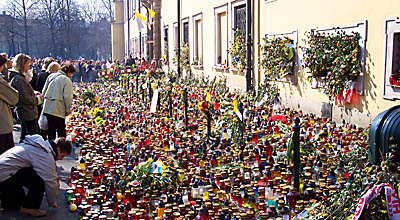
April 4, 2005, Mourners keeping
vigil in front of the palace of Krakow's bishops
where Pope
John Paul II once lived.
Krakow Mourns Its Beloved Son Pope John Paul II
The citizens of Krakow keep grieving over the loss of
the Pope whom they have seen as their Holy Father in
the most literal sense. Their sorrow overflows
households and
churches and manifests itself powerfully
in the streets as people pray and light candles and
put flowers at all sites associated with John Paul
II, one way or another. In the first place, the
Bishop’s Palace at Franciszkanska street where he
resided as the Krakow archbishop for fifteen years
before taking over the Holy See. And entertainment
as well as some
public events–from cultural to sports to
political ones–may be cancelled even beyond the
period of official mourning. Before he became Pope
John Paul II, Karol Wojtyla had lived in Krakow from
1938 to 1978, first as a student then priest and
academic and finally bishop and cardinal. As the
Pontiff he always remembered his city fondly and
visited Krakow as often as possible. Now the fellow
citizens hope that at least his heart will be buried
in the city one day.
Krakow’s New-Old Basilica
Krakow has got its tenth basilica May 15 as pope
bestowed that status on the 600-year-old Corpus
Christi church (Kosciol Bozego Ciala) in the heart
of the
Kazimierz area that stretches southeast
of the city’s central Old Town historical district.
Since 1405 the church has been in the possession of
the adjacent monastery of the order of Regular
Lateran Canons.
Taxpayers Make Krakow Second City in Poland
Krakow’s last year’s revenue of 1.81 billion zloty (an
equivalent of roughly $0.55 billion) makes it the
second richest municipality among Poland’s
provincial capitals after Warsaw, the country’s
biggest city and the seat of national government
that doubles as the metropolis of the Mazowieckie
province. Save Lodz all major Polish cities are
capitals of Poland’s 16 provinces.
Krakow Football At the Top, Again
Krakow’s top soccer team, Wisla, has won Poland’s 2005
football Championship. It’s the third title the club
secured in a row and the tenth one in its 99-year
history. In Poland the professional football league
plays from September to June with a winter break.
The Late Pope’s Aide to Run Krakow’s Archdiocese
John Paul II’s lifelong assistant, Archbishop
Stanislaw Dziwisz, 66, is taking over the Krakow
archdiocese. Pope Benedict XVI named his
predecessor’s private secretary for 27 years and the
Holy Sees’ eminence grise to replace archbishop
Franciszek Macharski who at 78 is three years past
the Church’s retirement age. In 1966 the then Krakow
archbishop Karol Wojtyla, future
pope John Paul II, made 27-year-old
Father Dziwisz his chaplain and would take him to
Vatican in 1978 as his closest aide till death last
April. Archbishop Dziwisz is to take hold of his new
Krakow duties at the end of August.
Most Serious Crime Stays Low
This year, till May 31, six homicides happened in
Krakow, city of 800,000 with numerous
visitors, all cases solved and killers arrested. In
2004 there were 24 murders of which three remain
unsolved to date.
Krakow Teen Wins Wimbledon
Krakow’s 16-year-old tennis player Agnieszka Radwanska
won this year’s Wimbledon women’s tournament for
juniors. It was the second competition on grass
surface she ever played in. Krakow’s teenage champ
has played tennis since five and her father, once
Poland’s tennis champion himself, remains her
coach.
Under Construction: Brand-new Steel Mill
Mittal Steel Poland, subsidiary of Indian
international giant Mittal Steel Co., has awarded
the contract to build a $350-million hot strip mill
in Krakow to Austria’s Voest Alpine. The
state-of-the-art mill, due 2006, will churn out 2.4
million ton of top-quality steel sheets per year.
Mittal Steel bought the bulk of Poland’s steel
industry, in that number Krakow’s mammoth HiS
steelworks on the city’s eastern outskirts.
MAN Trucked Next to Krakow
Germany’s truck maker MAN has decided to place its new
assembly plant in Niepolomice, Krakow’s satellite
town to the southeast. The factory, due in mid-2007,
is to employ 650 and produce up to 15,000 vehicles
per year. It will cost 96 million euro to build,
part of the amount covered by Polish government’s
grant. And the provincial government of
Malopolska has pledged 142 hectares of land
plus access road and railway.
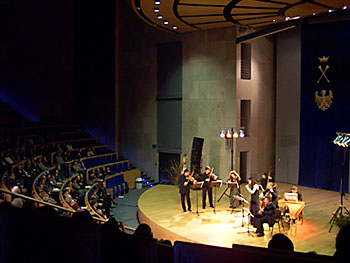
Centrally situated
Auditorium Maximum of the Krakow university, 35
Krupnicza street,
often doubles as a music hall for 1,200
Auditorium Maximum, Address to Remember
Krakow’s 650-year-old
Jagiellonian University, has got a
brand-new, state-of-the-art building for events with
large attendance. The long overdue
14.3-million-dollar Auditorium Maximum at 35
Krupnicza street seats 1,200 in its main
amphitheater-like hall whereas the smaller ones have
capacity of respectively 250 and 100. The posh
building, meant for everyday use as a set of lecture
halls, is to serve as a venue for university
gatherings on official occasions and double as a
conference center, also available for
performance arts and other
events.
Krakow, the Detour City
Wholesale modernization of Krakow’s crucial arteries
plays havoc with the city’s
transportation system this summer and
fall. Most consequential seems closing of the busy
junction next to the Krakow Glowny central station
where many of popular bus lines and tramways
crossed, now having been rerouted. In consequence
the nearest bus and tram stops are now to be found
two blocks east and west from the train station. The
junction is to stay closed till November.
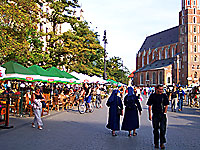
Rynek Glowny, Half-closed Due to Modernization
Renovation of the eastern half of
Krakow’s huge Rynek Glowny central square
is under way. The 5.7-million-dollar refurbishment
of the city’s unrivalled
hub entails replacing of the entire
surface, improvement of its foundations, and
thorough overhaul of underground installations – all
preceded by archeological excavations. Completion of
the works is scheduled for May 31, 2006. For the
meantime, Rynek Glowny’s multiple functions – from
everyday socializing to open-air concerts to
traditional festivals – squeeze into the
square’s western half, already renovated last year.
New Bus Depot, At Last
Krakow has got a long overdue brand-new depot for
long-distance buses. The modern bus station is
situated at Bosacka street, just east of the Krakow
Glowny main train station that abuts on the city’s
central Old Town historic district. One may
get there by taxi or on foot, walking the
underground passage that connects railway
platforms.
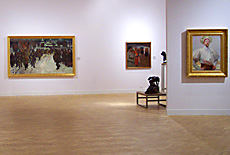
Modern Art Is Back at the Krakow National Museum, At
Long Last
Krakow National
Museum’s Gallery of the 20th-century
Polish Art has opened after a six-year-long, $
2.3-million overhaul marred by financial shortages
and technical glitches. The spacious 3,000-sq-m
gallery takes up the entire third floor of the
museum’s flagship edifice at 1, 3 Maja street and
houses nearly 500 outstanding works by Poland’s
modern artists, with a tilt towards those most
important for Krakow. Arranged with regard to
schools and trends rather than chronology the
exhibits provide a wide cross-section of the Polish
art, starting from the 1890s up to now.
Krakow Attracted 7,000,000+ in 2005
This year number of visitors, foreign and Polish, to
Krakow totaled over seven million, nearly a million
more than in 2004–recent estimates say. An average
tourist from abroad spends roughly $200 in Krakow
while a Polish one just $90 or so, and the aggregate
windfall for the city amounted to about $250 million
in the third quarter. The city attracted less
Americans and Israelis than in 2004 but proved
increasingly popular with Germans and Britons.
|