|

 Krakow Info home page Krakow Info home page
Krakow
for mobile
devices
facts
joys
sights
events
musts
hubs
business
food
hotels
travel
buys
tips
Your
Questions
Answered
|
UNESCO World Heritage Sites in
Krakow,
Poland and its vicinity.
Such monuments as Egyptian pyramids and the Great
Wall of China are important to the entire humankind, and
UNESCO (United Nations Educational, Scientific and Cultural
Organization) has listed them all as the world heritage
sites. Several of those world's treasures are in Krakow or
nearby.
|
|
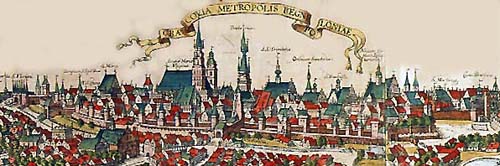
Krakow Old Town
Historical District
Poland’s prime
tourist attraction, the country's capital since 1038 to 1791,
Krakow boasts numerous landmarks. Its historic area's grid of
streets with the huge central Grand Square, Europe's largest in the Middle Ages, dates from
1257 and seems the last stage in the perfection of medieval city
planning. It is also the best example of that art.
|
|
|
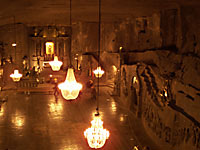
The Wieliczka Salt
Mine
Millions of visitors, the crowned heads and such celebrities as
Goethe and Sarah Bernhardt among them, have enthused over that
subterranean world of labyrinthine passages, giant caverns,
underground lakes and chapels with sculptures in the crystalline
salt and rich ornamentation carved in the salt rock. The last
900 years, when the Wieliczka Salt Mine has been worked,
produced 200 kilometers of passages as well as 2,040 caverns of
varied size.
|
|
|
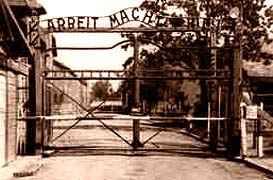
Auschwitz
The site of the Nazi notorious Auschwitz death camp is an
hour’s drive from Krakow. Between June 1941 and January 1945
about one million men, women and children perished in the three
Auschwitz concentration camps–i.e. Auschwitz proper, Birkenau
and Monowitz–and their more than forty sub-camps.
|
|
|
|
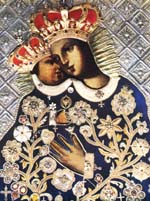
Calvary Sanctuary in
Kalwaria Zebrzydowska
400-year-old vast complex of 42 churches and chapels of all
shapes and sizes in addition to the central basilica and the
Franciscan monastery is biggest such compound in Europe.
|
|
|
|
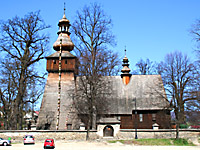
Wooden Churches of Malopolska
Hundreds of centuries-old timber churches grace the landscape
of the Malopolska
(Lesser Poland) province around
Krakow. Four of them have been entered in the UNESCO
List of the World Cultural and Natural Heritage in 2003. Those
four are situated in the villages of Sekowa, Binarowa, Lipnica
Murowana and Debno Podhalanskie. The Wooden Architecture Route
links them with 233 other places in Malopolska that boast
ancient timber buildings - churches, manor houses, cottages,
granaries, etc.
|
|
|
|
