|
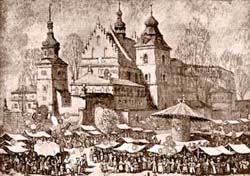
Krakow's Emaus Easter fiesta has drawn
crowds since the Middle Ages
Easter, the paramount Christian feast, has a special meaning
and a distinct quality in springtime Krakow with its rich
Catholic traditions and abundance of beautiful
churches. In the
ancient capital of Poland the festival spreads over four
days.
Good Friday
It's a workday in Poland but the
country's Catholics usually try to visit a
church to say a prayer on that very special and
solemn day. The faithful fast, eating just two
meals and no meat whatsoever.
Holy Saturday
On Ester Eve everybody, notably children, visits the parish
church with a basket of the traditional Easter foodstuff –
bread, eggs, ham, sausages, and a piece of horseradish – to
have them consecrated by priest. It is also the occasion to
see ‘the grave of the Lord Jesus’, arranged in a chapel or a
crypt, by which scouts, firefighters, the military, etc.
stand guard of honor. And the faithful keep long vigils.
Easter
Easter Sunday traditionally remains quiet and confined to
the family and the church. First thing in the morning the
faithful attend a predawn or very early Resurrection
service. Then the whole family has the festive common
breakfast featuring the victuals consecrated at the church
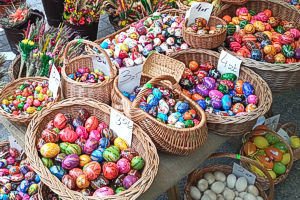
on Holy Saturday, with the ‘pisanki’ Easter
eggs–hardboiled and painted–as the highlight.
Easter Monday
Easter Monday is a public holiday in Poland, customarily
devoted to amusement and socializing. Krakow’s chief venue
remains the centuries-old Emaus
fair. Universal Poland’s tradition is ‘smingus-dyngus’,
i.e. splashing water over one another on the Easter Monday;
teenagers do it in the streets with zest and by bucketful.
At the same time you may come across the ‘smigusnicy’
masqueraders.
Krakow’s Easter Monday’s s fair
has drawn since the Middle Ages joyful crowds to the
Zwierzyniec area by the 800-year-old
convent of St.
Norbert's Premonstratensian order. The fair stems from
the ancient celebration of the All Souls Day, moved later to
November 2 in the church calendar. And not so long ago
during the fiesta innumerable stands and stalls sold clay
bells against evil spirits, magical wooden hatchets, and toy
birds representing souls. Now they trade mostly in homely
sweets and junk toys. Yet the Emaus
fair remained for Krakow dwellers the family Easter outing
of choice, mostly beloved by children. And teenagers find it
perfect for drenching each other with water, which is
Poland’s favorite Easter Monday sport.
Easter Tuesday
Although it's a workday nowadays, on Tuesday after Easter
another Krakow centuries-old fair, Rekawka, takes
place by the church of St. Benedict’s atop the Lasota Hill
south of the city center and/or next to a nearby ancient
barrow,
Mound of Krak, one
the city’s mysterious prehistoric earthworks. The fiesta
probably has roots in pagan rites in honor of the dead
celebrated here in the Dark Ages. Its feature used to be
scattering coins and sweets that boys fought over. There
were also bonfires and various contests, from fencing to
pole climbing. After WW II yearly Rekawka
fairs have attracted mostly children with simple amusements
and cheap sweets and toys overflowing stalls. There are
efforts recently to reinvent and enliven the fiesta as a
medieval festival.
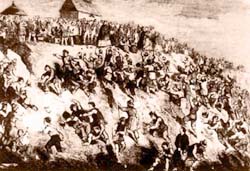
Krakow's centuries-old
fiesta of Rekawka: scattering coins and
sweets that boys fought over was once its
feature.
Social events
Profusion of social gatherings around Easter, from
formal banquets to wild parties, with the common theme of
egg-sharing and well-wishing is relatively new feature of
Krakow’s Easter festival.
Cultural attractions
Holy Week’s yearly
Misteria Paschalia Easter festival of music has managed
to bring world-class classical-music acts to Krakow in the
recent years and became the season’s cultural highlight.
Working hours on Holy Week and Easter
Monday through Saturday opening times on Holy Week are
as usual except shopping malls and supermarkets may keep longer
hours. On Easter Sunday and Monday all stores stay closed.
Museums and tourist attractions generally close for Easter
Sunday but many open for Easter Monday. Restaurants and other
eateries as well as coffee shops, pubs, bars, etc. stay open
every day. Most nightspots keep normal hours but on the Holy
Week and Easter there isn't much
nightlife in
Krakow anyway.
Advice:
In need of purchasing foodstuffs, toiletries, etc. on Easter
Sunday or Monday one may resort to gas stations that run small
shops and stay open nonstop. Medicines are sold by selected
pharmacies designated to remain on duty.
|