Krakow's Guide to the Best in the City.
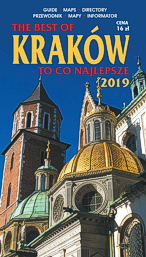 'The
Best of Krakow 2019' guidebook contains information
about the city's top attractions as well as best hotels,
restaurants, and services, plus maps and hundreds of photos.
It's the only guide to Krakow that includes GPS
coordinates for your smartphone, handheld, or other
satellite navigation device. Buy
your copy of 'The Best of Krakow 2019'. 'The
Best of Krakow 2019' guidebook contains information
about the city's top attractions as well as best hotels,
restaurants, and services, plus maps and hundreds of photos.
It's the only guide to Krakow that includes GPS
coordinates for your smartphone, handheld, or other
satellite navigation device. Buy
your copy of 'The Best of Krakow 2019'.
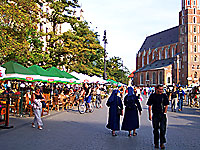
All roads lead to the Rynek Glowny square in Krakow. The
immense central plaza has always been the hub of the city’s
life. Krakow residents and visitors converge on its ten
acres for business and for pleasure - to shop in numerous
stores, to enjoy themselves in myriad restaurants, cafés and
clubs, to see each other, to attend major events from
traditional festivals to open-air concerts to political
rallies.
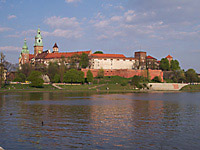
Wawel Hill basks in glory, fable, and the magic of things
eternal. Also, historical significance and its world-class
landmarks as well as accumulation of superb art and
unparalleled curiosities make this place a must for a
visitor to Poland.
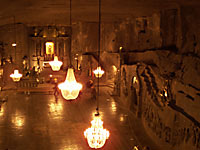
The subterranean world of labyrinthine passages, giant caverns,
underground lakes and chapels with sculptures in the
crystalline salt and rich ornamentation carved in the salt
rock have attracted enthralled visitors for centuries.
Kazimierz district with its mushrooming cafes and nightlife
spots has become Krakow’s equivalent of London’s Soho, Paris’
Quartier Latin, and New York’s Village. Its recreated Jewish
past and newborn reputation as a haven of artists and the
young have made the rundown area near the Old Town trendy
among tourists and the locals alike. Plus Kazimierz boasts
several first-rate landmarks.
1.
Wawel Cathedral.
Krakow’s monumental Gothic cathedral is the most venerated
Polish church and one of the most interesting landmarks of
Europe.
2.
Wawel Royal Castle.
Krakow’s Wawel castle was a royal residence for eight
centuries and the home to Poland’s three dynasties. Restored
to its historical grandeur, the Royal Castle features
first-rate period furniture and excellent works of art.
3.
Church of the Virgin Mary.
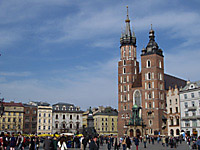
The imposing 14th-century basilica of the Virgin Mary at
Krakow’s central Rynek Glowny grand square, the best known
and liked church in Poland, has been traditionally the
city’s showcase temple. Also, it boasts the world’s arguably
greatest medieval altarpiece.
4.
Collegium Maius, the Great College.
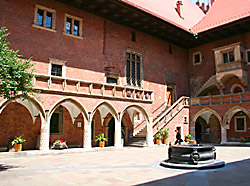
Impressive Gothic Collegium Maius college is one of the
world’s few medieval universities that have survived till
now. In its long history it was familiar to many of Poland’s
best minds, from Copernicus to John Paul II.
5.
Barbican and city walls.
Krakow’s barbican, the world’s biggest, is the crowning
achievement of the medieval art of fortifying. Together with
the nearby remnants of city walls it forms possibly the most
comprehensive example of municipal fortifications in the
Middle Ages that has survived in any of then European
capitals.
6.
Skalka sanctuary.
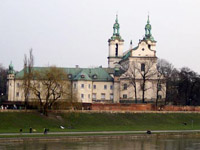
The scenic Baroque complex of the Skalka sanctuary, Poland’s
oldest shrine, sits on the Wisla river bank half a mile
downstream from the Wawel Royal Castle and the Wawel
Cathedral. The place has attracted pilgrims for 900 years
and doubled as the nation’s pantheon from the late 19th c.
7.
Sanctuary of Divine Mercy.
One of the world’s youngest Catholic shrines ranks among the
most popular pilgrimage destinations, attracting millions of
believers from all over the world to Krakow’s Lagiewniki
district as the heart of the worldwide movement to worship
Divine Mercy.
8.
Tyniec Abbey.
The spectacular Benedictine abbey in Tyniec upon the riverbank
some 12 km upstream from the Wawel Royal Castle, on the
western outskirts of today’s Krakow, boasts glorious and
dramatic history of nearly 1000 years rich in eventful
episodes.
9.
Old Synagogue.
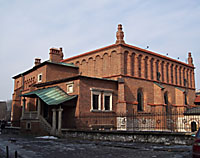
Krakow’s Old Synagogue ranks with the most ancient
Jewish places of worship in Europe. For centuries it was
central to the life of the former Jewish quarter in
Kazimierz.
10.
Bielany Monastery.
Cameldolite monks subject themselves to the extremely severe
rules of their order to live simple, peaceful, secluded life
close to God in their beautiful Krakow hermitage atop
Srebrna Gora (Silver Mountain), a ten minutes’ drive west
from Krakow’s center.
1.
Wawel Royal Castle.
2. Gallery of the 19th-Century Polish Art in the Cloth
Hall.
3.
Museum of Archeology, 3 Poselska street at Planty
gardens.
4. Palace of Bishop Erazm Ciolek, 17 Kanonicza street.
5.
Krakow National Museum, Main Gallery at 1, 3 Maja
street.
6.
Schindler's
Factory, 4 Lipowa street street.
7. Museum of Aviation, 39 Jana Pawla II street.
8. Rynek Underground beneath Rynek Glowny central square (entrance
at the Cloth Hall opposite St Mary's church).
9. Old Synagogue, 24 Szeroka street.
10. The Hipolits' House, 3 Plac Mariacki square.
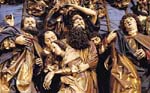
1. The Virgin
Mary's altarpiece by Veit Stoss
in the basilica of the Virgin Mary at Rynek Glowny central
square.
2.
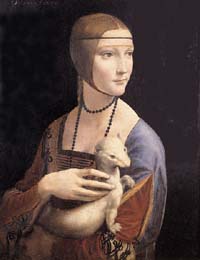
Leonardo da Vinci's 'Lady with an Ermine' in
The Czartoryskis' Museum at 19 s. Jana street and Pijarska
street.
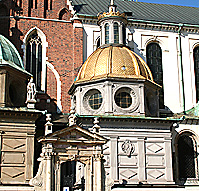
3.
Sigismund chapel of the Wawel Cathedral.
4.
Wawel arrases, the royal tapestries in the Royal
Castle.
5.
Sigismund the bell in the Wawel Cathedral.
6.
Wyspianski's window in the basilica of St. Francis,
Franciszkanska street at Planty gardens.
7.
Swiatowit idol in the Museum of Archeology, 3
Poselska street at Planty gardens.
8.
Our Lady of Piasek in the Carmelite church (Kosciol
Karmelitow) at 19 Karmelicka street.
9.
Kmita's chasuble in the Cathedral Museum on Wawel
Hill.
10.
Ice-age hairy rhinoceros in the Museum of Natural
History at 9 sw. Sebastiana street.
1. Royal Road through the Old Town.
2. Planty garden ring, round historic Krakow.
3. Across Kazimierz historical district.
1.
Calvary sanctuary in Kalwaria Zebrzydowska.
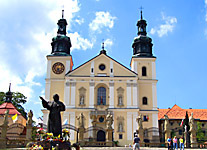
UNESCO’s World Heritage Site. 42
baroque churches and chapels make up Europe's largest
Calvary sanctuary 33 km southwest of Krakow. The complex,
famous for its miraculous image of the Virgin Mary and Holy
Week’s festivals, dates back to 1600.
2.
Auschwitz-Birkenau.
Gory site of the Nazi infamous Auschwitz death camp in
Oswiecim, an hour's drive west from Krakow, is left largely
intact as a monument in memory of over million people who
perished here from 1941 to 1945 and testimony to genocide.
3.
Tatry Mountains.
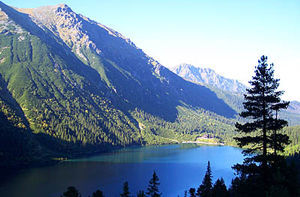
The alpine range of Tatras, some 120 km south of Krakow, has
been mostly turned into a national park long ago. Stunning
views, pristine nature, and nearly 250 km of hiking trails.
Plus winter sports galore as well as rock climbing, cave
exploration, paragliding, etc.
1. The long
Christmas in Krakow.
2. Midsummer Fiesta of Garlands on the first Saturday after
June 24.
3. Lajkonik parade on the next Thursday after Corpus Christi
Feast.
Best value hotel in Krakow.
1.
Hotel Amadeus at 20 Mikolajska street /five stars/
2. Hotel Royal at 26-29 sw. Gertrudy street /three stars/.
3. Hotel Europejski at 5 Lubicz street /three
stars/.
1. Albertina Restaurant & Wine
at 3 Dominikanska street with the Polish modern cuisine.
2. Pod Aniolami at 35 Grodzka
street with the old Polish cuisine.
3. Wiezynek at 16 Rynek Glowny
central square the Polish cuisine.
4. Tradycyja at 16 Rynek Glowny
central square the Polish and Italian cuisine.
Best amber: Boruni at 60 Grodzka street and Amber Museum at
2 Sw. Jana street.
Best shopping mall: Galeria Kazimierz at 34 Podgorska street.
|