Krakow Info website
doesn’t use cookies nor gathers personal data but advertisers and
services providers may do it on their own responsibility.
Privacy policy.
Muzeum Narodowe w Krakowie - National Museum in
Krakow - is Poland's biggest museum. It's also the oldest
of the nation's national museums - it was founded in 1879. The
museum can boast 11 branches, 11 galleries, 21 departments, two
libraries, and 12 conservation workshops. Its diverse collections
total about 800,000 items - from art to handicrafts to historical
costumes to rare books to manuscripts to old coins and weapons -
libraries and deposits inclusive.
Departments of the National Museum in Krakow
Possessions of the museum have been grouped into 21 sections
organized according to both the character and the age of items and
called departments.
1st Department /Dzial I/. The Polish Painting and Sculpture
before 1764.
Paintings and sculptures created on Polish soil from the Middle Ages
through the 18th century.
2nd Department /Dzial II/. The Modern Polish Painting and
Sculpture.
Works by the outstanding Polish artists of the late 18th century and
the 19th century.
3rd Department /Dzial III/. Prints, Drawings and Watercolours.
4th Department /Dzial IV/. Decorative Art and Material
Culture.
Artifacts of the Polish as well as foreign origin, the latter often
associated with Poland.
5th Department /Dzial V/. Military Collections.
Some 11,000 items, mostly various types of weapons and armor.
6th Department /Dzial VI/. Oriental Art.
7th Department /Dzial VII/. Numismatics Collection.
Coins, including a fine collection of antique Greek, Roman and
Byzantine coinage, as well as medals and banknotes, Polish and
foreign.
8th Department /Dzial VIII/. Old Prints and Manuscripts.
Superb collection of 26,000-plus volumes.
9th Department /Dzial IX/. Jan Matejko's Collections. Objects exhibited and stored in the Jan Matejko House at 41
Florianska street, a branch of the National Museum in Krakow devoted
to the life and works of the 19th-century Polish painter Jan Matejko.
10th Department /Dzial X/. Collections of the Karol
Szymanowski Museum in Villa Atma in Zakopane. Holdings of the Krakow National Museum’s branch in Zakopane
devoted to the life and works of Karol Szymanowski, Poland’s
outstanding composer of classical music of the first half of the
20th century. They include his manuscripts, a collection of book,
letters, and documents as well as period furniture, etc.
11th Department /Dzial XI/. Ancient Art.
Collections of antiquities, mostly of the Egyptian, classical Greek,
Etruscan, and Roman origin.
12th Department /Dzial XII/. European Painting and Sculpture.
Western European art from the Middle Ages to the 20th century.
13th Department /Dzial XIII/. European Decorative Art.
Collections of the Western European finest handicrafts, furniture,
china, etc.
14th Department /Dzial XIV/. The Armory.
Collections of ancient weapons and armor, Polish and other European as
well as oriental, including items once owned by Poland’s kings and
famous military commanders.
15th Department /Dzial XV/. Graphic Art Room.
Prints, drawings, architectural designs, and printing plates in the
collection of The Czartoryskis Museum.
16th Department /Dzial XVI/. The Czartoryskis Library.
225,000-plus volumes from incunabula to ancient prints to old maps.
17th Department /Dzial XVII/. The Czartoryskis Archives and
Collection of Manuscripts.
Some 13,000 original documents and manuscripts of historical figures
concerning Poland and other European countries, also the USA.
18th Department /Dzial XVIII/. Orthodox Church Art.
Old icons and other church art of the Orthodox Church, mostly from the
southeastern part of Poland, the rest from Russia and the Balkans.
19th Department /Dzial XIX/. Textiles.
Over 20,000 pieces of clothing and fabric, including a superb
collection of chasubles and other church vestments from the early
14th century on.
20th Department /Dzial XX/. Old Photography.
Collection of Polish and foreign photos from years 1850 to 1945
consists mostly of prints – also on such materials as leather and
oilcloth – plus plates and daguerreotypes and totals over 80,000
items,
21st Department /Dzial XXI/. Studio of the Iconography of
Krakow. 9,000-plus views of Krakow – panoramas of the city, its streets,
squares, landmarks, exteriors and interiors of buildings.
Note: Only part of the Krakow National Museum's collections is
permanently displayed in any of its ten branches, some are available
only to scholars, some are exhibited from time to time, and many of
the museum's possessions have never been shown to the public.
The Main Building is the Krakow National Museum's official seat and
its principal venue for temporary art shows. Also, it contains two
permanent exhibitions
XX + XXI. Polish Art Gallery
Gallery of Decorative Art
The main building of the National Museum in Krakow is closed on
Mondays. Open Sunday from 10 a.m. to 6 p.m., Tuesdays 10 a.m. to 7 p.m.,
Wednesdays 10 a.m. to 6 p.m., Thursdays 10 a.m. to 6 p.m., Fridays 10 a.m. to 7 p.m., and Saturdays from 10 a.m. to 7 p.m.
Free admission on Tuesdays (permanent shows only).
at 19 Sw. Jana street and Pijarska street.
Postal address: ul. sw. Pijarska 15, 31-017 Krakow, Poland. Phone (+48) 123705460, email
muz-czart@muzeum.krakow.pl
The museum holds permanent exhibitions of
European Painting
European Decorative Arts and Pulawy Memorabilia
Arms
Antiquities
Temporary exhibitions take place in the
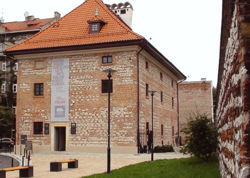
nearby building of the 16th-century Arsenal at 8 Pijarska street.
Open
Sunday from 10 a.m. to 6 p.m., Tuesdays 10 a.m. to 7 p.m.,
Wednesdays 10 a.m. to 6 p.m., Thursdays 10 a.m. to 6 p.m., Fridays 10 a.m. to 7 p.m., and Saturdays from 10 a.m. to 7 p.m.
The museum stays closed on Mondays.
It's advisable to book tickets online well in advance.
Free admission on Tuesdays (permanent shows only).
Palace of Bishop Erasmus Ciolek / Palac Biskupa Erazma Ciolka
at 17 Kanonicza street.
Postal address: ul. Kanonicza 17, Krakow, Poland. Phone
(+48) 124291558 and 12424937.
The museum consists of two permanent exhibitions
Art of Old Poland (the 12th century through 18th century)
Orthodox Art of the Old Polish-Lithuanian Republic
Open
Sunday from 10 a.m. to 6 p.m., Tuesdays 10 a.m. to 7 p.m.,
Wednesdays 10 a.m. to 6 p.m., Thursdays 10 a.m. to 6 p.m., Fridays 10 a.m. to 7 p.m., and Saturdays from 10 a.m. to 7 p.m.
The museum stays closed on Mondays.
Free admission on Tuesdays (permanent shows only).
Gallery of the 19th-cetury Polish Art / Galeria Sztuki
Polskiej XIX wieku.
Postal address: Sukiennice, Rynek
Glowny 1, 31-011 Krakow, Poland. Phone (+48) 124244600.
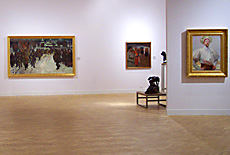
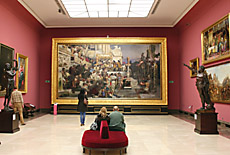
Situated on the upper floors the Cloth Hall (Sukiennice), in the
middle of the Old Town’s central square, the newly refurbished
cradle of the National Museum in Krakow retains the precious
nineteen-century atmosphere besides modern facilities. Its
collection consists of the best paintings of Poland’s top artists of
the late 18th century till the end of the 19th century, i.e. from
the enlightenment to the romanticism to realism to impressionism and
symbolism.
Closed on Mondays.
Open
Sunday from 10 a.m. to 6 p.m., Tuesdays 10 a.m. to 7 p.m.,
Wednesdays 10 a.m. to 6 p.m., Thursdays 10 a.m. to 6 p.m., Fridays 10 a.m. to 7 p.m., and Saturdays from 10 a.m. to 7 p.m.
Free admission on Tuesdays (permanent shows only).
Roof terrace is accessible every day between 10 a.m. and 11 p.m.
The Szolaysky House / Kamienica Szolayskich
at 9 Plac Szczepanski square and Szczepanska street.
Postal address: Plac Szczepanski 9, 31-011 Krakow, Poland. Phone
(+48) 122928183 ext. 84 or 85, also (+48) 124227021, fax (+48)
122928189, e-mail szolayscy@muzeum.krakow.pl
Open
Sunday from 10 a.m. to 6 p.m., Tuesdays 10 a.m. to 7 p.m.,
Wednesdays 10 a.m. to 6 p.m., Thursdays 10 a.m. to 6 p.m., Fridays 10 a.m. to 7 p.m., and Saturdays from 10 a.m. to 7 p.m.
The museum stays closed on Mondays.
Free admission on Tuesdays (permanent shows only).
EUROPEUM Center of European Culture
/ Osrodek
Kultury Europejskiej
EUROPEUM
at 6 Plac Sikorskiego square.
Closed. To reopen as the Stanislaw Wyspianski Museum.
House of Jan Matejko / Dom Jana Matejki
at 41 Florianska street.
Postal address: ul. Florianska 41,
31-019 Krakow, Poland. Phone (+ 48) 124225926 or 124230408, fax
(+48) 122921005, email dommatejki@muz-nar.krakow.pl
Biographical museum of the 19th-century Polish great painter Jan
Matejko.
Open
Sunday from 10 a.m. to 4 p.m., Tuesdays 10 a.m. to 5 p.m.,
Wednesdays 10 a.m. to 4 p.m., Thursdays 10 a.m. to 4 p.m., Fridays 10 a.m. to 4 p.m., and Saturdays from 10 a.m. to 5 p.m.
The museum stays closed on Mondays.
Free admission on Tuesdays (permanent shows only).
Houseand Garden of
Jozef Mehoffer /
Dom i Ogrod Jozefa Mehoffera
at 26 Krupnicza street.
Postal address: ul. Krupnicza 26, 31-123
Krakow, Poland. Phone (+48)
4335840 or 124335841.
Biographical museum of the noted Polish painter, born 1869, in the
house he bought in the 1930s and where he lived till death in 1946.
Open
Sunday from 10 a.m. to 4 p.m., Tuesdays 10 a.m. to 5 p.m.,
Wednesdays 10 a.m. to 4 p.m., Thursdays 10 a.m. to 4 p.m., Fridays 10 a.m. to 4 p.m., and Saturdays from 10 a.m. to 5 p.m.
The museum stays closed on Mondays
Free admission on Tuesdays (permanent shows only).
Emeryk Hutten-Czapski
Museum / Muzeum Emeryka Hutten-Czapskiego
at 12 Pilsudskiego street.
Postal address: ul. Piłsudskiego 12,
31-109 Krakow, Poland. Phone (+48) 124335840 or 124335841.
Ticket office phone (48) 124335843..
The museum holds collections of coins,
banknotes, and medals, old prints, manuscripts, Polish memorabilia,
and works of decorative arts, the bulk of them amassed by collector
Emeryk Hutten-Czapski in the second half of the 19th century.
Open
Sunday from 10 a.m. to 4 p.m., Tuesdays 10 a.m. to 5 p.m.,
Wednesdays 10 a.m. to 4 p.m., Thursdays 10 a.m. to 4 p.m., Fridays 10 a.m. to 4 p.m., and Saturdays from 10 a.m. to 5 p.m.
The museum stays closed on Mondays
Free admission on Tuesdays (permanent shows only).
Jozef Czapski
Pavilion / Pawilon Jozefa Czapskiego
at 12 Pilsudskiego street.
Postal Address: ul. Piłsudskiego 12,
31-109 Krakow, Poland. Phone (+48) 124335840 or 124335841. Ticket
office phone (48) 124335843.
The modern building in
the backyard of the Emeryk Hutten-Czapski Museum shows the life
and art of Polish artist and writer Jozef Czapski (born 1896, died
1993). The Pavilion is also a venue for temporary shows of modern
art.
Open
Sunday from 10 a.m. to 4 p.m., Tuesdays 10 a.m. to 5 p.m.,
Wednesdays 10 a.m. to 4 p.m., Thursdays 10 a.m. to 4 p.m., Fridays 10 a.m. to 4 p.m., and Saturdays from 10 a.m. to 5 p.m.
The museum stays closed on Mondays
Free admission on Tuesdays (permanent shows only).
Karol Szymanowski Museum in the Villa Atma in Zakopane / Muzeum im.
Karola Szymanowskiego w Willi 'Atma' w Zakopanem
at 19 Kasprusie street in the town of Zakopane,
120 kilometers south of Krakow.
Postal address: ul. Kasprusie 19, 34-500
Zakopane, Poland. Phone/fax (+48) 182013493, email atmamuzeum@wp.pl
Biographical museum dedicated to life and music of composer Karol
Szymanowski.
Open
Sunday from 10 a.m. to 4 p.m., Tuesdays 10 a.m. to 5 p.m.,
Wednesdays 10 a.m. to 4 p.m., Thursdays 10 a.m. to 4 p.m., Fridays 10 a.m. to 4 p.m., and Saturdays from 10 a.m. to 5 p.m.
The museum stays closed on Mondays
Free admission on Tuesdays (permanent shows only).
The Czartoryski Library / Biblioteka Czartoryskich
at 17 Sw. Marka street.
Postal address: ul. sw. Marka 17, 31-018
Krakow, Poland. Phone (+48) 124221172 or 124224079, e-mail
bczart@poczta.onet.pl (Department of Manuscripts) and bczart@tlen.pl
(Department of Prints).
Open on weekdays from 8 a.m. to 1:45 p.m. plus on Saturdays from 9 a.m. to 1:45 p.m.
History of the National Museum in Krakow
National Museum was founded by the City Council in Krakow in 1879 as
Poland's first national institution dedicated to collecting and
exhibiting fine arts. Initially it was situated in the upper rooms
of the Cloth Hall (Sukiennice)
standing in the middle of Krakow’s Rynek Glowny
central square. Now the same building houses the Gallery of the
19th-cetury Polish Art, a branch of the Krakow National Museum.
In the ensuing decades the National Museum in Krakow grew into the
country’s by far biggest museum, mostly thanks to generous donations
of wealthy Poles who often gave it entire collections and sometimes
buildings to hold them. At first the museum concentrated on
gathering the then contemporary Polish art but as early as the early
20th century it adopted a wide scope of activity including
handcrafts, foreign art, antiquities, historical memorabilia, books,
and coins.
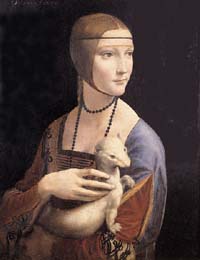
In 1950 the Krakow National Museum incorporated the Princes
Czartoryski Museum together with its superb collections and the
Czartoryski Library and Archives. In 1991 they were formally handed
over to a charity founded by Adam Karol Czartoryski, the heir of
their former owners, but by mutual arrangement the National Museum
in Krakow remained their curator and guardian.
In December 2016
The Princes Czartoryski Foundation has sold the Czartoryski museum and the
library, complete with all their possessions, to the Polish
government which has granted them to the Krakow National Museum.
Taking photos and videotaping in the Krakow National Museum.
Visitors may photograph and videotape free of charge at every
exhibition but the use of flash and tripods is prohibited.