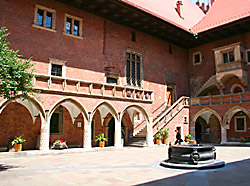
The Great College of Krakow's
Jagiellonian University.
The 650-year-old Jagiellonian University
moved in to the building at the corner of the Jagiellonska and
Sw. Anny streets in 1400, when King Vladislav II Jagiello
bought the house with funds his late wife, queen-saint Jadwiga,
had earmarked for the renewal of Krakow’s alma mater. Thus the
Grand College, or Collegium Maius, was born.
The long and grand history of Krakow's Collegium Maius.
The oldest college of the Polish oldest and best university, was
rebuilt by the end of the 15th century as a splendid late-Gothic
edifice around a vast courtyard with surrounding arcades and a
well of 1517 in the center. Professors lived and worked
upstairs, while lecturing downstairs. In the 1490s they had
Copernicus among their students, and the astronomer that
revolutionized entire European science remains the most
illustrious of Krakow university’s graduates together with
Pope John Paul II.
Over centuries a whole university quarter has arisen around the
Collegium Maius, while the old college became first the
university library and then the university museum rich in
unrivaled exhibits.
Visiting the Collegium Maius.
The beautiful college courtyard is accessible free of charge
daylong plus on odd evenings when it provides picturesque
background for open-air theater or musical events. At 11 a.m., 1
p.m., and 3 p.m. (plus 9 a.m. and 5 p.m. in summer) the courtyard clock performs
a little show with
wooden figures of kings and famous professors parading to solemn
music.
The Museum of the Jagiellonian University in the Collegium Maius
shows upstairs its splendid historic rooms with original
furnishings, good collection of the old European art, unique
science instruments, and varied memorabilia. The opening hours
are from 10 a.m. to 3 p.m. on Mondays, Wednesdays, and Fridays,
to 6 p.m. on Tuesdays and Thursdays, and to 2 p.m. on Saturdays.
Admittance for individual visitors is free of charge on
Tuesdays, from 3 p.m. to 6 p.m. Otherwise a single ticket costs
12 zloties (PLN). It's always advisable to book
tickets to the university museum in advance via phone at (+48)
126631307.
Downstairs the museum of the Collegium Maius organizes
frequent temporary exhibitions. Plus there is a permanent
educational show, 'The Whole Thing Is a Number',
which
demonstrates through 65 experiments that math permeates our
daily lives -
open on weekdays and Saturdays from 10 a.m. to 2 p.m.
There is a
gift shop
and a cellar
cafe
on the premises.
The Collegium Maius has facilities for the disabled.
Watch online
videos of the Collegium Maius in Krakow plus more
information.
Wawel Royal Castle
Home to three dynasties of Poland's monarchs. Its
stately halls and exquisite chambers are filled with priceless
art, best period furniture and rare ancient objects. The
collection of the 16th-century monumental Flemish
tapestries is matchless.
Wawel Cathedral
Poland's impressive national shrine shelters plenty of
superb church art. Its giant bell of 1520 ranks with the
world's largest. Most Polish kings and their family members are
buried in the cathedral, its chapels and crypts.
Grand Square
Krakow’s central Grand Square (Rynek Glowny), the
largest plaza of medieval Europe and one of the world’s finest
with its spectacular landmarks, has remained the hub of the city
since the 13th century.
Basilica of the Virgin Mary's
The immense Gothic church, Krakow's principal temple
since the 13th century, shelters the world's greatest Gothic sculpture among its many excellent works of art
Cloth Hall
The world's oldest shopping mall has been in business
for 700 years. The present Renaissance edifice dates from 1555.
Town Hall Tower
Krakow's leaning tower was built by the end of the 13th
century.
City Walls
700-year-old main city gate with adjoining mighty walls
and towers.
Great Barbican
Awesome 500-year-old unmatched masterpiece of medieval
military engineering
Planty Garden Ring
Park of 30 varied gardens among old trees round
Krakow's Old Town historical district
Krakow mummies
Picturesque 17th-century church and monastery shelter
numerous naturally mummified bodies in their crypts.
Kanonicza Street
The most beautiful of Europe's ancient
streets,arguably.
Old Synagogue of Kazimierz
The grandest of Krakow's seven historic
synagogues.
|