Museum in Oskar Schindler’s Factory
Krakow’s fabled Oskar Schindler's Factory of Enameled Vessels
‘Emalia’ has been turned into a modern museum devoted to the wartime
experiences in
Krakow under the five-year Nazi occupation during the
World War II. The museum takes up the sprawling administration
building of the defunct plant at 4 Lipowa street, in the city’s grim
industrial district of Zablocie on the right bank of the Wisla river.
Ingenious exhibitions combine period artifacts, photos and documents
with multimedia and set-piece arrangements in an attempt to create a
full-immersion experience.
Beyond Oscar Schidler’s Museum.
Oskar Schindler, his factory, and
the fate of its Jewish workforce feature prominently in the museum.
Roughly a sixth of the museum’s permanent exhibition is dedicated to
them. The rest shows prewar Krakow, the German invasion in 1939,
Krakow as the capital of Poland under the Nazi occupation, the
sorrows of everyday living in the occupied city, family life, the
wartime history of Krakow Jews, the resistance movement, the
underground Polish state, and lastly the Soviet capture of the city.
The centerpiece of the part of the
exposition dealing with Oskar Schindler himself is his office
fortuitously preserved over the intervening years.
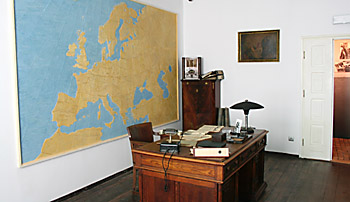
Oskar Schindler's office with his desk, erotic art, and huge map he
used to demonstrate Nazi conquests in Europe.
History of ‘Schindler’s Factory’ in Krakow, Poland.
Oskar Schindler arrived to Krakow
hot on the heels of the German invasion in September 1939. As a
member of the Nazi party and an agent of the German military
intelligence he managed to appropriate the factory which had been
set up by a group of Jewish businessmen in 1937. Krakow’s two Jewish
proprietors who became dependent on Schindler, Abraham Bankier and
Samuel Wiener, provided him with necessary capital. The factory
originally known under its Polish name as Fabryka Naczyn
Emaliowanych i Wyrobow Blaszanych ‘Rekord’ was renamed Deutsche
Emailwarenfabrik (DEF). Under Schindler’s control the plant at 4
Lipowa street continued to produce cookware and varied metal
vessels, primarily for the German army. He accomplished ambitious
plans of the rapid expansion of production facilities. Schindler
also succeeded in launching a munitions division so his factory was
able to contribute directly to the Third Reich’s war effort as
supplier of cartridge cases and fuses for bombs and artillery
shells. He reduced costs by replacing the original Polish staff with
cheap labor from the
Krakow Jewish ghetto the Nazis organized not far from
Schindler’s factory. When Germans liquidated the ghetto in 1943 and
moved the remaining Jews to the
Plaszow concentration camp, Schindler opened its branch
on the premises of his factory complete with barbed-wire fences and
watchtowers.
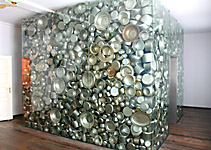
'Tin-ware
Sarcophagus' - erected opposite Schindler's desk in his spacious
private office - is one of several monuments commemorating Jewish
workers in the factory turned museum.
In the face of the Soviet Red Army's advances Schindler relocated,
with the blessing of the German authorities, his munitions business
and its workforce in the late 1944 to the branch of Gross-Rosen
Concentration Camp in Bohemia’s Brunnlitz. About 1,200 Jewish
prisoners from Krakow survived there to be liberated by the Soviets
on May 8, 1945. In 1993 Steven Spielberg immortalized Schindler’s
Factory in his movie ‘Schindler's List’.
From 1948 to 2002 the retooled
plant at 4 Lipowa street manufactured parts for telecommunications
equipment produced by Krakow’s company Telpod.
In June 2010 the Schindler Factory
(Fabryka Schindlera) opened as a branch of the City of Krakow
Historical Museum.
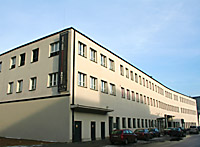
Museum in Schindler's Factory in Krakow.
The historical museum’s facilities
of Oskar Schindler’s Factory consists of three parts, namely its
permanent show, space set aside for temporary displays, and the
screening room. The permanent exhibition of Schindler’s Factory is
entitled ‘Krakow under Nazi Occupation 1939-1945’ which correctly
summarizes its contents. The screening room is meant as the venue
for movies, lectures, meetings, and varied cultural or educational
activities.
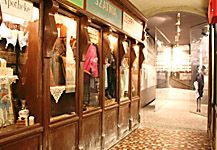
Krakow's wartime street recreated in
Schindler's Factory.
Accessibility of Oskar Shindler's Factory.
The museum at 4 Lipowa street is
situated some three kilometers southeast from Krakow's Old Town
historical center, a five minutes' drive barring traffic jams,
across the Wisla river. The simplest access routes run through Most
Kotlarski bridge east of Lipowa and Most Powstancow Slaskich west of
it. Also, it isn't easy to find parking in the area.
The nearest bus stop within
walking distance of Schindler's Factory is Krakowska Akademia stop
at Herlinga Grudzinskiego street. The closest tram stop is situated
at Plac Bohaterow Getta square.
GPS coordinates of Schindler's
Factory are N50 02.840 E19 57.711
Opening hours of Schindler's Factory and ticket prices.
From April 1st through October
31st the museum in Oscar Schindler’s
Factory is open on weekends, Tuesdays, Wednesdays, Thursdays, and
Fridays from 10 a.m. to 8 p.m. and on Mondays between 10 a.m.
and 4 p.m. with the exception of the first Monday of every month
when the museum closes at 2 pm.
November through March the museum of Oscar Schindler’s
Factory opens at 10 am and closes at 6 p.m. every day except Mondays
when it's open from 10 a.m. to 2 pm.
Note: visitors aren't let in later
than ninety minutes before the closing time.
Ticket prices at
Schindler's Factory .
Individual visitors can see
Shindler’s Factory free of charge on Mondays but entry is
limited to a fixed quota for safety reasons. Otherwise a standard
ticket costs 19 zlotys (PLN) while reduced rate is 16 zlotys. A family ticket costs
50 PLN. Guided tours in English – groups of twenty at least – cost
20 zlotys per person. Online ticket booking is possible at the website
of the City of Krakow Historical Museum: www.mhk.pl
Contact information for Shindler's Factory.
Postal address of the museum in
Schindler's Factory is Fabryka Schindlera, ul. Lipowa 4, 30-702
Krakow, Poland. Phone / fax (+48) 122571017 or 122570095 or
122570096. E-mail: fabrykaschindlera@mhk.pl
Oskar Schindler's Factory
constitutes one of the branches of the City of Krakow Historical
Museum (Muzeum Historyczne Miasta Krakowa) with the headquarters at
35 Rynek Glowny (central square).
|