Zygmunt Bell - Dzwon
Zygmunta in the Krakow Wawel Cathedral
Remember the famous Big
Ben's chime? In Krakow you can see, and actually even touch,
an equal of the London bell of the Houses of Parliament.
Huge Zygmunt (Sigismund) bell, Dzwon Zygmunta in Polish, is
nearly 9 feet across too. At the same time Krakow’s Big Sig
is a third heavier, weighing 18 metric tons. It is also some
350 years older than its English counterpart, having been
cast in Krakow in 1520.
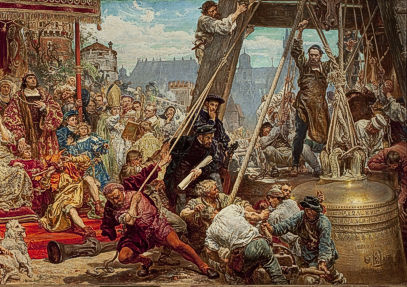
Jan Matejko
painting of 1874 depicts the Zygmunt bell being raised to
the belfry of the Krakow cathedral.
The giant which ranks
among the world's largest bells is one of the many
attractions of the Wawel Cathedral (Katedra
Wawelska)
in Krakow. It's decorated with reliefs of St. Stanislav and
St. Sigismund as well as the arms of Poland and Lithuania.
It was donated to the Wawel Cathedral by Sigismund I the
Old, King of Poland and Grand Duke of Lithuania, when Krakow
was the Polish capital. "Big Sig" still is where it was hung
in 1521, i.e. at the top of a 14th-century tower turned into
the Cathedral's belfry near the Wawel Royal Castle.
The
beautifully deep toll of
the huge Sigismund Bell is heard far away on important
Church holidays and at the historic moments for the nation.
And it needs the strength of ten men to ring the giant bell
every Christmas, New Year Day or Easter Sunday.
Seeing the Zygmunt Bell and the Wawel Cathedral
Flocks of visitors buy tickets,
queue up at the belfry entrance in the Cathedral and climb
several flights of stairs of the Wieza Zygmuntowska tower in
order to see the famous Zygmunt and, usually, touch its
660-pound clapper. They say the wish then whispered is to
materialize soon. Also the view of Krakow from the belfry
seems worthwhile.
Note:
Tickets for the Wawel Cathedral including Zygmunt's Bell and
the
royal crypts
are sold at the box office situated in the building opposite
the main entrance to the cathedral.
Ten bells of the Wawel
Cathedral
The Wieza Zygmuntowska
belfry's four other bells are somewhat smaller and even
older as they date from years 1455 to 1514. The Wawel
Cathedral has also a second belfry, called the Tower of
Silver Bells (Wieza Srebrnych Dzwonow), with five bells as
well.
The layout of the Wawel Cathedral
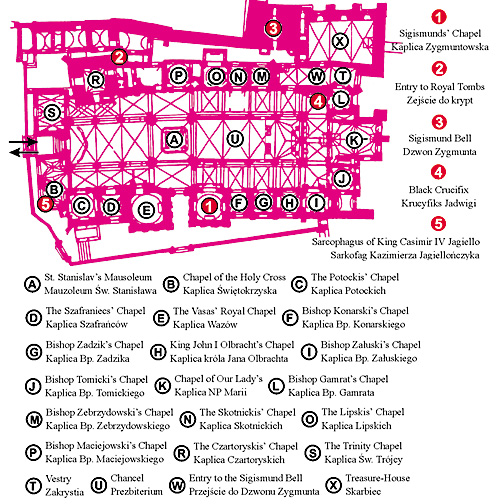
|
Wawel Hill
Wawel Hill in Krakow, the mecca of every Pole and a
must for foreign tourists, is a microcosm of Polish history and
culture.Wawel Cathedral
Poland's impressive national shrine shelters plenty of
superb church art.
Wawel Royal Castle
Home to three dynasties of Poland's monarchs. Its
stately halls and exquisite chambers are filled with priceless
art, best period furniture and rare ancient objects. The
collection of the 16th-century monumental Flemish tapestries is
matchless.
Sigismund Chapel
The pearl of Renaissance architecture and art.
Every inch of its ideally proportioned stone walls and dome is
covered with fine sculptures..
Royal Tombs
Poland's medieval rulers are buried under their
sarcophagi in the Cathedral's nave. Visitors can also see crypts
with the tombs of the Renaissance and later monarchs
Black Christ's Crucifix
650-year-old, 13-foot-tall remarkable sculpture of the
Savior provided guidance to Queen-Saint Jadwiga in the 14th
century and has heard prayers of the faithful ever since.
Other Krakow Curios:
Prettiest Leonardo
da Vinci
World's greatest
medieval sculpture
Window of awe
Subterranean
wonder world
Renaissance pearl
Miraculous images
8-foot golden
crown
Signal trump
Nativity beauties
Krakow mummies
Ice-age rhino
|
Regular ticket price to the WAWEL CATHEDRAL
(plus the Zygmunt Bell and the Royal Tombs)
is a equivalent of about 2.5 euro
Monday-Saturday open to tourists 9.00 a.m. to
5.00 p.m.
On Sundays and Holidays open to tourists 12.30
p.m. to 4.00 p.m.
The Wawel Hill is accessible to visitors daily
since April through September from 6.00 a.m. to
8.00 p.m. and since October through March from
6.00 a.m. to 5.00 p.m. The Royal Castle's arcaded courtyard is off limits
half an hour before the closing time.
Exhibitions in the Royal Castle are closed on
Christmas, New Year's Day, Easter Sunday,
November 1 and November 11.
The following are permanent
exhibitions of the Wawel Royal Castle:
Royal Chambers
(State Rooms) - historical interiors, tapestry
collection of Sigismund II Augustus, royal
portraits, Italian Renaissance furniture,
Italian and Dutch painting of the 14th to 17th
century.
Royal Private Apartments - rooms where
the Polish royalty lived, period furniture and
art.
Crown Treasury and Armory
- regalia, jewelry, precious weapons, armors and
caparisons; Polish and West European.
Oriental Art - Turkish tents
and banners, Turkish and Persian weapons and
carpets, Chinese and Japanese ceramics.
The Lost Wawel - archaeological
and architectural reserve of the early
11th-century church of St. St. Felix and
Adauctus' with surroundings; objects excavated
by archeologists on the Wawel Hill; ornate stove
tiles of the 16th and 17th century. Plus
multimedia presentation of the Wawel Hill's
history.
Dragon's Den - big
cave said to be the fiery monster's
hideout.
Admission terms and fees might be
subject to changes. For inquiries and booking
please contact the Tourist Service Office (BOT),
Wawel 5, 31-001 Kraków, Poland, tel.: (+48 12)
4225155 ext. 291, tel./fax: (+48 12) 4221697
|
|
|