 |
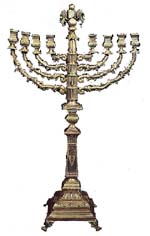
The Kazimierz Jewish Town
In 1495 King Jan I Olbracht transferred
Krakow Jews to the nearby royal city of Kazimierz,
which gave rise to its once bustling Jewish quarter and a
major European center of the Diaspora for the next three
centuries. With time it turned into virtually separate and
self-governed 34-acre Jewish Town, a model of every
East European shtetl,
within the limits of the gentile city of Kazimierz. As
refugees from all over Europe kept coming to find the safe
haven here, its population reached 4,500 by 1630.
Jewish Landmarks in the Kazimerz district of Krakow
Strolling old narrow streets of the eastern half of Krakow’s
Kazimierz district one still finds a unique atmosphere of
the Jewish past of this area. To it attest also the exhibits
of the Museum of
Judaism at 24 Szeroka street, in the stately
brick building of the
Old Synagogue, dating back to the 15th century
and rebuilt to Renaissance tastes in the 1560s. Other
interesting
synagogues are Isaac's Synagogue at 25 Jakuba
street (17th c., Baroque), High Synagogue at 38 Jozefa
street (16th c., late-Gothic/Renaissance), Tempel at 24 Miodowa
street (19th c., neo-Romanesque), Popper's Synagogie at 16
Szeroka street (17th c., Baroque), and Remuh Synagogue at 40
Szeroka Street (l6th c., Renaissance) with the adjoining
Remuh Cemetery.
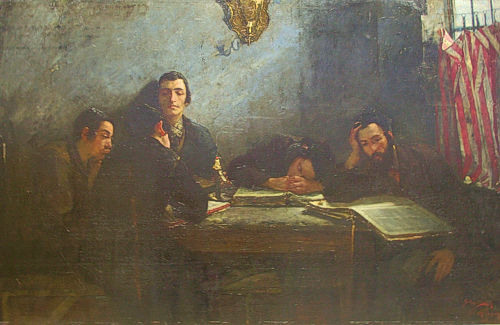
Yeshiva, Samuel Hirszenberg's
painting of 1887 in the
Krakow National
Museum's Cloth Hall gallery.
Kazimierz's Old Jewish Cemetery
Remuh cemetry by the Remuh Synagogue at 40 Szeroka Street was
named after the nickname of famous 16th-century rabbi and
religious writer Moses Isserles. Even today pious Jews keep
coming to pray at his grave and the graves of their other great
men who were buried here. The cemetery was used from 1551 to
1800. Its hundreds old tombstones, dating mostly from the
Renaissance, as well as its history and surroundings make the
Remuh Cemetery one of Europe's most interesting.
Holocaust in Krakow
In March 1941 the German war administration forced all Krakow
Jews to resettle in the newly created
ghetto south of the Kazimierz area. The Nazis
liquidated it only two years later on March 13, 1943. Most of
the 17,000 ghetto inhabitants perished in the Nazi concentration
camps, such as Auschwitz-Birkenau
and
Krakow’s Plaszow
whose site has been turned into a commemoration park with an
impressive monument.
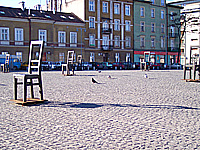
Memorial to victims
of the Krakow ghetto in the form of oversized bronze chairs on
the Plac Bohaterow Getta.
Bustling and Lively Again
Kazimierz district has become newly fashionable in the recent
decade. With its mushrooming
cafes and
nightlife spots, it has become Krakow’s equivalent of
London’s Soho, Paris’ Quartier Latin, and New York’s Village.
Kazimierz district's recreated Jewish past and newborn
reputation as a haven of artists and the young have made the
rundown area near the
Old Town trendy among tourists and the locals alike.
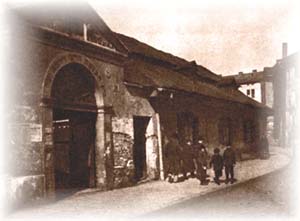
Watch online
videos of Jewish sites in Krakow
|

Stroll through
Krakow's Kazimierz District
Old Synagogue
Krakow's synagogues
Center for Jewish
Culture
Jewish ghetto in Krakow
KL Plaszow concentration camp
Auschwitz
Poland's prime tourist
attraction and a must in Central Europe boasts numerous
world-class monuments, charming vistas, delightful atmosphere,
and the best restaurants.
In the proximity
of Krakow
Krakow is Poland's tourist mecca, and also a gateway to
many other must-see sites in the region.
|

