|
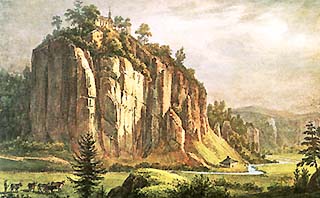
The 17th-century
Blessed Salomea's Hermitage atop steep rock in the park's
heart.
Ojcow National Park in Poland
It may be, with its area of mere 21.5 sq.
kilometers, the smallest of Poland’s twenty national parks
but the Ojcow National Park (Ojcowski Park Narodowy in
Polish) ranks among the most attractive recreational areas
in the country, and it is just a 15 minutes’ drive – or 24
kilometers – northwest of
central Krakow (road 794 via Zielonki to the town of
Skala, right turn to road 773 to the Pieskowa Skala
castle).
Few national parks in the world can boast so many
picturesque and worthy architectural monuments as the
Ojcow’s one has within its limits. This and the most scenic
landscape with an abundance of many-shaped limestone rocks –
some tall for fifty meters or more – such as the park’s
trademark 25-m-tall ‘Hercules’ Bludgeon’, rather than
wildlife bring in here roughly 400,000 visitors a year. Most
of them comes between mid April and mid November. Also
numerous caves, often easily accessible, prove to be a
magnet for many.
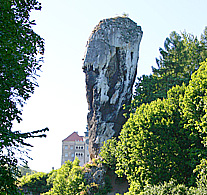
The park's trademark 25-metre-tall "Hercules' Bludgeon" rock
by the Pieskowa Skala Castle is said to be the work of
the devil.
The core of the Ojcow National Park consists in the Pradnik
river valley with a road running along it as a backbone – most
opportunely for motorists. The thing is there are too many of
them, notably on weekends, so the two most convenient parking
lots, at the village of Ojcow and by the Pieskowa Skala Castle,
tend to be packed.
The flora and fauna of the Ojcow National Park
The Ojcow National
Park, established in 1956, preserves valleys of two small
rivers, Pradnik and Saspowka. The park includes 385 hectares of
the strict nature reserve. Its fauna consists of about 6,000
animal species (insects make up the bulk). There are 134 species
of birds such as hawks, woodpeckers, owls, kingfishers, and
herons. The Ojcow National Park boasts also 15 species of bats
whose colonies inhabit many of the park’s 400 or so known caves.
Also, one endangered species of reptile, a harmless snake
gniewosz plamisty (smooth snake, Coronella austriaca). A program
to reintroduce beavers into the park was successfully launched
in 1985.
Plant species of the Ojcow
National Park number about 900. Its area largely consists
in forests of common broadleaf trees.
Attractions in the Ojcow National Park
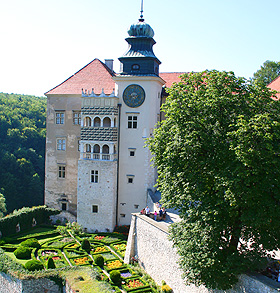
Pieskowa Skala
Castle, called ‘a pearl of the Polish
Renaissance’, at the Ojcow park’s northernmost end, among
forests on a hill overlooking the picturesque Pradnik river
valley, dates back to the mid 14th century. In the 16th century
it underwent refurbishment after the fashion of the north
Italian Renaissance. Since 1970 it has been home to a European
art museum, a branch of Krakow’s Wawel Royal Castle.
The castle of Pieskowa Skala lies on
the
Trail of Eagle Nests (red marks), a hiking
route that runs from Krakow to Czestochowa linking a chain
of medieval castles that used to guard Poland's western
frontier.
Ojcow village in the park’s heart boasts the remnants of
the 14th-century castle: Gothic gate, octagonal tower, and ruins
of the chapel. Popular as a tourist destination since the 18th
century, Ojcow was a fashionable health resort through the
second half of the 19th century, and a few buildings in the
period’s so-called ‘Ojcow style’ remained, e.g. two former
hotels: one turned into the Nature Museum, the other into the
post office.
Blessed Salomea’s Hermitage (Pustelnia Bl.
Salomei) at Grodzisko village, atop a tall upright rock
halfway between Ojcow and the Pieskowa Skala Castle, dates back
to the 17th century, and was built in the place of the
13th-century nunnery. Baroque church is surrounded by the
17th-century statues of Polish saintly medieval prices and
princesses.
King Lokietek Cave (Jaskinia Lokietka) near
Ojcow is 240 m long and fabled as the place where the Polish
ruler hid from his rival’s overwhelming forces in 1300 before he
eventually regained the Krakow throne.
Dark Cave (Jaskinia Ciemna) south of Ojcow is
147 m long and was home to Poland’s earliest known inhabitant
who dwelled here some 120,000 years ago.
|
In the proximity of Krakow
Krakow is Poland's tourist mecca, and also a gateway to
many other must-see sites in the region.
Polish national parks near Krakow
Malopolska
Province
Poland map
City of Krakow map
Krakow
Poland's prime tourist attraction and a must in Central
Europe boasts numerous world-class monuments, charming vistas,
delightful atmosphere, and the best restaurants.
|