|
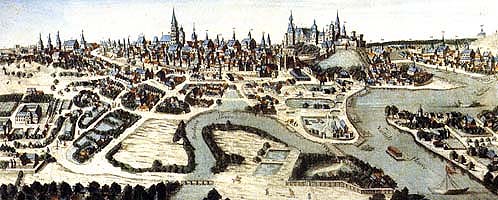
Krakow in the mid 18th century.
Very long history of Krakow
Archeological finds prove humans have lived in the Krakow
area since 200,000 BC at least, and some 50,000 years ago a
hamlet with a factory churning out stone tools prospered on
Krakow’s central Wawel Hill where
the Royal Castle stands now. In 965 a travelling merchant
from Spanish Cordoba wrote about Krakow as the bustling
trade center of Slavonic Europe, and recent excavations
confirm it.
Krakow in the Middle Ages
Its northern neighbors of the Piasts’ dynasty incorporated
the Krakow province into their principality in the 990s and
thus the Kingdom of Poland was born. In the year
1000 Krakow got its own bishop, and in 1038 the city became
Poland’s capital and its Wawel Royal
Castle the residence of Polish kings. Mongols demolished
Krakow in the mid 13th century, so the then ruler, Prince
Boleslaw the Shy, established it anew
in 1257 and endowed with both self-government and
immense trade privileges.
The historic glory of Krakow
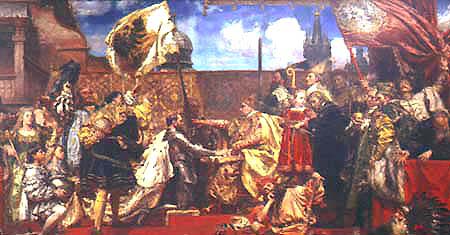
Poland’s monarch
Sigismund I
(1506-1548) ruled over vast realms from the Baltic to
the Black Sea. In 1525 he received the oath of allegiance from
Albrecht I, prince of Prussia, on the Krakow
central Square. Concurrently his brother Wladyslaw was the king of
Hungary and the Czech lands.
The city’s Golden Age came by the end of the 15th century
when it was the thriving metropolis of a vast and prosperous
kingdom stretching from the Black Sea to the Baltic Sea.
Krakow remained Poland’s official capital till 1791 but from
1609 on successive kings after their coronation in Krakow
chose to reside in Warsaw where the country’s political
center moved with them (monarchs kept returning to Krakow
for good: to be buried in the Wawel
Cathedral).
The city's ups and downs
Throughout the 18th century Krakow suffered a series of
sieges, foreign occupations and plunders. After Russia,
Prussia and Austria invaded and divided Poland between
themselves in the 1790s, the last empire took Krakow. In
1815 the Congress of Vienna created an independent,
miniature Krakow Republic forcibly incorporated into the
Austrian empire in 1846. After Emperor Franz Joseph I
granted Krakow the municipal government in 1866 the city
became Poland’s vibrant center of gravity again, which
eventually led to the 1918 rebirth of the nation in the
aftermath of the World War I.
Through the second world war and afterwards
Krakow remained the most important city in the southwest
part of the Republic of Poland till September 1939 when
Hitler’s Third Reich and Stalin’s Soviet Union invaded the
country and divided it between themselves. On the
German-occupied territory the Nazis created a protectorate
with their governor-general’s residence in Krakow.
Fortunately, the
historic city of Krakow survived almost intact the
Soviet offensive in January 1945. After the WW II Krakow
retained its status as Poland’s second most important city
and has vied with Warsaw for the cultural supremacy.
|