|
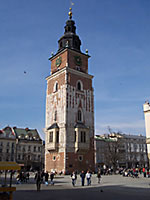
Krakow Squares and Plazas.
City of Krakow can boast numerous squares that provide a
wealth of quality public spaces.
The Old Town's famous Rynek Glowny immense central plaza,
lined with sidewalk cafes and historic buildings, is a must
for every tourist. Also other squares – notably Maly Rynek,
Plac Szczepanski, and Plac Nowy – are popular venues for
open-air shows and other events. Some old piazzas, such as
Plac Marii Magdaleny and Plac Mariacki, enchant with their
spectacular scenery. Some, e.g. Plac Matejki or Plac Sw.
Ducha, provide fine vistas of the nearby monuments. At the
same time a number of squares in Krakow, including Rynek
Kleparski next to the Old Town historic district, have
retained the traditional role as popular marketplaces.
The most notable squares in Krakow.
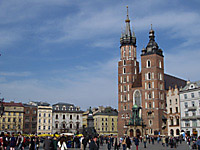
Grand Square (Rynek Glowny,
often wrongly translated as 'Market Square'), has been
Krakow’s hub ever since the city’s Old
Town historic district got the present grid of streets
in the 13th century. The huge 10-acre square, the largest of
all Europe’s medieval cities, is a curio in itself. Its
chief landmarks are the Renaissance 16th-century
Cloth Hall in the center (now home to the
museum of the 19th-century art upstairs and numerous
ground-floor stalls with souvenirs), the Gothic 13th-century Town Hall Tower, and the grand Gothic
14th-century basilica of the Virgin
Mary’s. Yet practically each of 47 buildings at the
square boasts a considerable historical and/or architectural
value.
Plac Szczepanski square, just one block west from
Krakow’s huge central Grand Square, appeared in the city’s
medieval street grid in the early 19th century when a
13th-century church and the adjacent buildings were
demolished. Edifice at its corner with the Jagiellonska
Street dates back to 1798 and is the oldest
theater house in this country. In 1907 it was given a
modernist facelift and now shelters the Teatr Stary theater,
reputed Poland’s best company of players. The
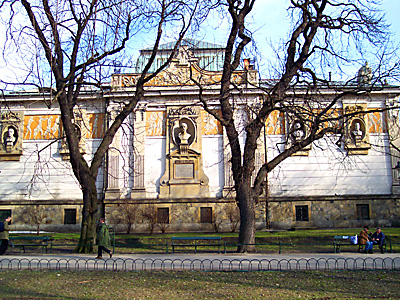
Palace of Art
(Palac Sztuki), a monumental modernist temple to the cult of
fine arts, which took up the square’s western side in 1900,
remains one of the city’s most prestigious venues for
temporary exhibitions. Since 1964 it has got a rival
exhibition hall in the bunker-like structure just across
the street where mostly the latest art is shown nowadays.
After a refurbishment the Plac Szczepanski square has got a
stylish appearance in 2010. Its most spectacular feature is
a computerized fountain performing the light-sound-and-water
show in front of the Palace of Art.
Maly Rynek Square, situated one block east from the huge
central Grand Square in Krakow’s
medieval compact grid of streets, ranks among the city’s most
scenic places. For centuries this rectangle served as the meat
market – crucial function in the medieval economy. The eastern
side of the Maly Rynek Sq. is lined by picturesque houses of
burghers. They face an array of church buildings across the
square, at the foot of the towering chancel of the basilica of the Virgin Mary’s with its
famous 14th-century stained-glass widows.
Ulica Szeroka Square is so long and narrow that it is
officially called a street (Polish ‘ulica’). It once
served both as a marketplace and a forum of
Kazimierz’s Jewish Town, the capital in everything
but name of Poland’s Jews from the 16th century through the 19th
century. At the square’s northern end one finds the 16th-century
mansion of Polish noblemen, The Jordans, which has undergone
several major revamps in the ensuing centuries. The opposite end of the
square, where king Jan I Olbracht settled Jews from Krakow in
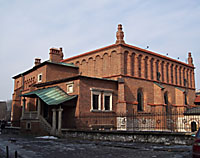
1495, is taken up by the grand Renaissance
Old Synagogue of 1570, now the Museum of Judaism. It adjoins remnants of
the 14th-century Kazimierz’s city walls. The 16th-century modest
R’emuh Synagogue at 40 Szeroka Street is placed next to the
R’emuh burial ground; and the 17th-century Baroque building of
the former Popper Synagogue still stands at 16 Szeroka Street.
|
Krakow Streets
Krakow on Foot
The best way to enjoy old Krakow is afoot.
Stroll Up the
Royal Road
Stroll Round the
Grand Square
Stroll through
Krakow's Kazimierz District
In the footsteps of Pope John Paul
II
Street art in Krakow
Map of Krakow
Krakow's Old Town
map
|