|

 Krakow Info home page Krakow Info home page
Krakow
for mobile
devices
facts
joys
sights
events
musts
hubs
business
food
hotels
travel
buys
tips
Your
Questions
Answered
|
The Planty Route, Circling Krakow's Old Town central
historic district.
Leafy ring of some 30 public gardens encloses
Krakow’s Old Town
historic district. In the 1820s it has taken up the
emptied area of 52 acres when once formidable
fortifications round the medieval city were demolished
save the northern flank with the main gate. The two-mile-plus walk
through the Planty
garden loop
encircles the Old Town, linking many of its monuments.
|
Krakow's suggested itineraries
The best way to tour the historic Krakow is on
foot.
|
|
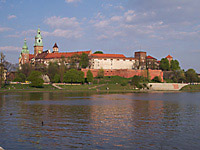
Wawel Hill with the Royal Castle
|
Clockwise, one finds most of the Old Town's
landmarks on the right, starting with the neo-Gothic brick
seminary of 1899 at the foot of
Wawel Hill below the towering
Wawel Cathedral. Next, a garden wall partly hides the seat of the
Archeology Museum in the former 17th-century Carmelite monastery
turned into an infamous Austrian prison in 1797. After
crossing Poselska street one passes by the
17th-century Franciscan brewery that belongs to the
monastery visible beyond a green, adjacent to the Romanesque
basilica of St. Francis (13th century). The imposing
17th-century Bishops Palace takes up the
opposite side of
Franciszkańska
street. From 1964 to 1978 it was home to Archbishop Karol
Wojtyła, the future
Pope John Paul II. Next, on the corner of Wislna street, one finds
the former Norbertine convent of the 17th century, its chapel
turned now into a Greek Catholic church.
|
Stroll Up the Royal Road
Stroll Round the
Grand Square
|
|
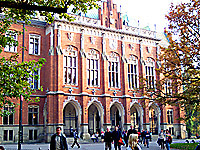
Collegium Novum, the Jagiellonian
University's headquarters.
|
Then the Planty
gardens border the
Krakow university quarter,
passing by four of its colleges, i.e. Collegium
Wróblewskiego of the late 19th century, the flagship
neo-Gothic Collegium Novum
of 1887 (the 1771 figure of the Virgin Mary between them, on
the left Piłsudskiego
street offers a
vista of the
Kosciuszko Mound
of 1823), Collegium Physicum of the early 19th century
with the 1900 monument to Copernicus in front of it, and the
fine baroque Kolegium Nowodworskiego of 1643.
The splendid baroque church of St. Anna of 1703 takes
up the opposite corner of Sw. Anny street.
|
Walk across Krakow's Kazimierz historic district
Planty ring of gardens
|
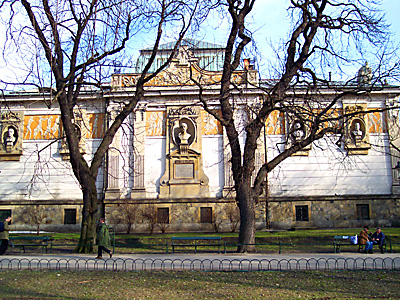
Palace of Arts,
the 1901 gallery. |
Some 100 meters further
on the
Bunker of Art, a drab
concrete exhibition hall of 1965, neighbors on its elegant Art
Nouveau counterpart, the
Palace of Art
of 1901. Next the
Planty borders a Franciscan monastery with the 1673
baroque church of St. Casimir. |
Krakow's
central Old Town historic district
|
|
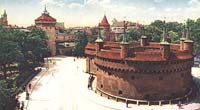
Krakow's city walls
- the 700-year-old main city gate with adjoining mighty walls
and towers plus the awesome
barbican.
|
After a bend east the gardens abut the
relics of Krakow’s
medieval fortifications with the
city’s main gate, the 13th-century Gothic
Brama Florianska,
the powerful
barbican of 1499, the municipal Arsenal of
1566, two towers of the 14th century, another one of the 15th century, and the
connecting walls.
|
Map of the Old Town
Map of Krakow
|
|
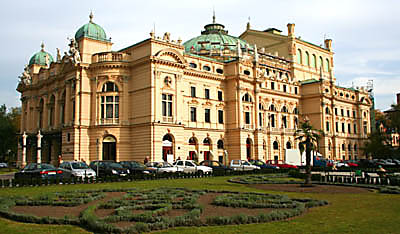
Teatr
Slowackiego theater of 1903 has long doubled as opera
building.
|
Soon turning south, the Planty runs past the imposing
theater
building, Teatr Slowackiego, of 1903 and the adjacent fine
Gothic church of the Holy Cross of the 14th century.
Further 200 meters bring you to the foot of Grodek
with a Dominican convent and its baroque church of the
Snowy Mother of God that dates from 1635. They took
place of the 16th-century aristocratic palace that had
replaced a 14th-century citadel whose fortified gate is
easily discernible. On the left, across the Planty
and Westerplatte
street, one may see the 1879 neo-Gothic firehouse and the
adjoining building of the Main Post Office of 1889.
Beyond Sienna street the Planty borders a vast
complex of the Dominican monastery with the 13th-century
Krakow Gothic church of the Holy Trinity. After
crossing Dominikanska street one passes by the
17th-century Observant convent and next the Poor Clares’
convent that dates back to 1318, with the visible relics of
the medieval city walls. Beyond them the dome of the
17th-century baroque church of SS Peter and Paul
stands out. Lastly, the Planty gardens stretch
between a hotel of 1896 (on the left) and the former
Royal Arsenal dating back to 1643 (on the right), at the
foot of the east wing of the
Wawel Royal Castle.
|
Getting around Krakow
|
|
|
|
