Krakow's Royal Way
Royal Road in Krakow,
the ceremonial route kings and the like took across
Poland’s historical capital, links most of its marvels.
As the city had 8 gates, sure the Monarchs entered through
the main one, the Gothic Floriańska gate of circa 1300 and–since
1499–the mighty Barbican before it; now both nicely
preserved with the adjacent city walls and towers.
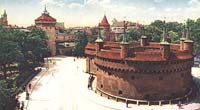
City Walls
700-year-old main city gate with adjoining mighty walls
and towers.
From the
gate the Floriańska street, from time immemorial
Krakow’s busiest, leads to the central square. At 45
Floriańska street the Jama Michalika cafe (est. 1895) boasts
period art nouveau decor; at no. 41 there is The House of Jan Matejko, the great
19th-century painter’s residence turned into a museum. The
street ends at the foot of the 14th-century Gothic
basilica of the Virgin Mary’s, the city’s chief and
biggest church. Every full hour the ancient Krakow Signal is trumpeted to the world’s
four sides from its taller, crowned tower.
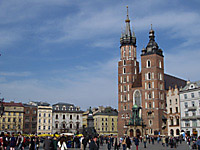
Basilica of the Virgin Mary's
The immense Gothic church, Krakow's principal temple
since the 13th century, shelters the world's
greatest Gothic sculpture among its many excellent works of art.
The basilica overlooks the
Grand Square–Europe’s largest medieval city plaza, with
the Renaissance
Cloth Hall of 1555 in the midst and the 13th-century
Gothic Town Hall Tower in the background. In the
square’s southern corner one finds the tiny 11th-century
church of St. Adalbert’s (Polish Wojciech), its original
Romanesque form barely veiled by a Baroque renovation, with
an archeological preserve underground.
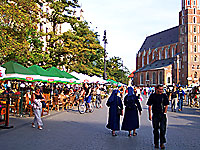
Grand Square
Krakow’s central Grand Square (Rynek Glowny), the
largest plaza of medieval Europe and one of the world’s finest
with its spectacular landmarks, has remained the hub of the city
since the 13th century.
One block down the
near Grodzka street there is a square flanked by two grand
13th-century temples. Right, the Romanesque basilica of St. Francis’, famous for its
turn of the century’s splendid stained-glass modernist
windows and floral frescos, adjoins a Franciscan monastery.
Left, the Gothic basilica of Holy Trinity dwarfs the
adjacent Dominican monastery. Both monasteries boast the
14th-century great cloisters, full of art. The Franciscan
one neighbors the Renaissance Wielopolskich Palace of 1560,
a city hall since 1865. Halfway down the Grodzka street turn
right to the Senacka street and next instant left to find
the scenic Kanonicza street,
arguably one of Europe’s finest, lined with stately and
mostly Renaissance houses.
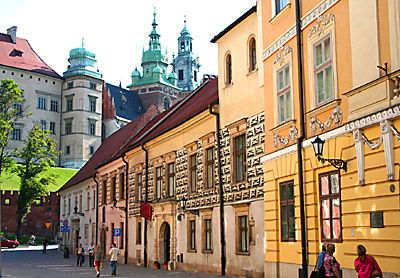
Kanonicza Street
The most beautiful of Europe's ancient streets, arguably.
In its half a charming square
unveils the white facade of the imposing Jesuit Baroque
church of St. St. Peter and Paul’s of 1619 next to the
grand Romanesque church of St.
Andrew’s of circa 1090. From 1951 to 1963 Father Karol Wojtyla, future Pope John Paul II, dwelled at 19 and 21
Kanonicza St, where his former rooms have been turned into a
part of the Archdiocese Museum, otherwise showing
mostly church art.
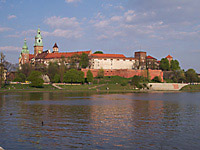
Wawel Royal Castle
Home to three dynasties of Poland's monarchs. Its
stately halls and exquisite chambers are filled with priceless
art, best period furniture and rare ancient objects. The
collection of the 16th-century monumental Flemish
tapestries of Wawel is matchless.
The street ends just at the foot of
the Wawel Royal Castle atop the
Wawel Hill and next the Royal Road climbs up the
elevation to the double gates (of the 20th c and 17th c
respectively) in its walls. The steps on the left behind the
second gate lead to the Wawel
Cathedral, while the next turn left will bring you to
the Royal Castle’s entrance.
Select restaurants
on the Royal Route.
Any following information has been provided by respective
restaurants on their sole responsibility.
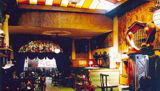
Jama Michalika restaurant
and art cafe
Polish cuisine.
Address 45 Florianska street. Phone/fax (+48) 124221561. Email
poczta@jamamichalika.pl Website www.jamamichalika.pl
The original vibrant Art Nouveau interior of famous Jama
Michalika, established in 1895, dates back to 1908. The place was immortalized
by its early 20th-century patrons: the greatest artists, actors and men of
letters of the period, whose caricatures still adorn the walls. The restaurant
is situated at the Royal Road, five minutes walk from the central square, close
to Brama Florianska city gate. It serves traditional Polish dishes.
Dinners for organized groups from 5 euro per person.
We arrange banquets, special events, weddings, and business
gatherings at negotiable prices.
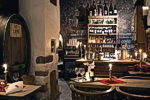
Pod Aniolami
restaurant
Polish cuisine.
The Pod Aniolami – “Under
the Angels” restaurant is an extraordinary place, famed far
and wide for its marinated meats, grilled over beech
hardwood fire, and other old Polish dishes. The restaurant’s
historical 13th-century interiors and brilliant
cuisine, based on the Polish culinary traditions, will make
you soak up the atmosphere of the Medieval Kings’ City of
Cracow. At “Under the Angels” time stood still and one can
still find the ambience of old Cracow here. Beautiful
interiors and excellent cuisine attract renowned guests from
all over the world. On the ground floor we invite you to The
Chamber of the Wawel Castle’s Comptroller where one can
admire the 18th-century polychromes during private banquets.
There is also a charming year-round open garden with
a mosaic fountain to which one can always drop a coin
wishing to come back to this unusual place.
Meal for two without wine -
about
40 euro
Address: 35 Grodzka street.
Phone:
(+48) 124213999.
Suggested itineraries in
Krakow, on foot
The best way to enjoy old Krakow is afoot.
Stroll Round the
Grand Square
Stroll through
Krakow's Kazimierz District
Planty walk round the Old Town
In the footsteps
of Pope John Paul II
|