In the Footsteps of Pope John Paul II in Krakow.
The greatest citizen of
Krakow, Poland
resided in Vatican from 1978 to 2005. Before having taken
over the Holy See as Pope John Paul II, Karol Wojtyla had
lived in Krakow for four decades – practically through his
entire adult life until his assumption of the papacy. Here
he spent his formative years as a student and then as a
young priest, a theologian and a philosopher, a playwright
and a poet. And here he made most of the breathtaking ascent
from the position of a humble curate at Krakow’s church of
St. Florian’s to university professor to Krakow bishop to
cardinal to the Vicar of Christ.
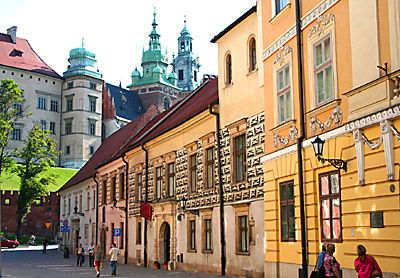
Kanonicza street
in Krakow.
In the foreground - two adjacent houses where John Paul II
lived
from 1951 to 1963 have been turned into the Archdiocese Museum
with a department devoted to the late Pope.
Krakow's route of Pope John Paul II
If one intends to visit places connected with the life of
the man who shepherded the Church into its third millennium,
he should start at Debniki, Krakow’s residential
district vis-a-vis the Wawel Hill
across the Vistula river. Born in the
town of Wadowice some 30 miles southwest of Krakow,
18-year-old student Karol Wojtyla moved in to a Debniki
basement room at 10 Tyniecka street in 1938. Next September
Nazi Germany invaded Poland and under their five-year-long
occupation he was forced to work in the nearby Zakrzowek
quarry while concurrently studying at an underground
theological seminary. First thing every morning he heard
Mass and went to Communion at the large, modern Debniki
parish church of St. Stanislaw Kostka’s where also young
Father Wojtyla would say the second Mass in his life on
November 3, 1946. He said his first Mass a day earlier in
the 12th-century Crypt of St. Leonard’s under the Wawel Cathedral where Polish kings
and national heroes are laid to rest.
Could the newly ordained priest expect that barely seventeen
years would elapse and he would take the Wawel Cathedral
over as the Krakow Archbishop? Twelve of these seventeen he
was to live at the foot of the cathedral, at the splendid
Kanonicza street. Father Wojtyla resided at 19 Kanonicza
street from 1951 till 1958, when he became bishop; and at
the adjacent no. 21 till 1963, when he became the
Krakow archbishop. Now both those houses are turned into the
Archdiocese Museum which exhibits the church art.
Yet Father Wojtyla’s old room looks as if he only
recently walked out, complete with the furniture he once
used. Added are such John Paul II’s memorabilia as
coins and medals minted in his honor and robes he
wore as university professor, bishop, cardinal and, finally,
the Pope. There is also the exhibition of varied gifts
presented to Pope John Paul II during his long pontificate.
A five minutes’ stroll down the most charming Kanonicza Street and then through
the Planty gardens will
bring you to the gate of the stately Bishops’ Palace at 3
Franciszkanska street whose ample first-floor rooms were
home to His Eminence Cardinal Karol Wojtyla since 1963
to 1978. Previously he had lived in the palace as a
seminarist throughout 1945 and was ordained in its
chapel on the
All Saints Day AD 1946. In October 1978
Cardinal Wojtyla left for Rome to participate in the
conclave which elected him the Pope. In the ensuing year he
visited his native Krakow for the first time as John
Paul II,
staying again briefly in the Bishops’ Palace. In the
palatial courtyard one can see his statue commemorating the
most famous master of the place.
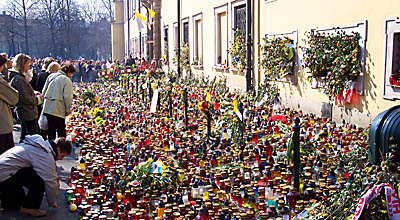
April 4, 2005, Mourners keeping
vigil in front of the palace of Krakow's bishops where Pope
John Paul II once lived.
Wawel Cathedral
Poland's impressive national shrine dates from the 14th
century and shelters plenty of superb church art. The Sigismund Chapel is a masterpiece of the
Renaissance art and architecture. Giant Zygmunt bell of 1520 ranks with the world's largest. Most Polish kings are buried here together with the greatest
national heroes.
Wawel Hill
Wawel Hill in Krakow, the mecca of every Pole and a
must for foreign tourists, is a microcosm of Polish history and
culture.
Basilica of the
Virgin Mary's
Immense Gothic church, the city of Krakow's principal
temple since the 13th century, boasts the world's greatest Gothic sculpture among its many excellent works of art.
Huge stained-glass widows of the chancel date from the 14th
century.
Royal Tombs
Poland's medieval rulers are buried under their
sarcophagi in the Cathedral's nave. Visitors can also see crypts
with the tombs of the Renaissance and later monarchs.
Krakow Old Town
Historical District
Poland's prime tourist attraction and a must-see in
Central Europe boasts numerous world-class monuments, charming
vistas, delightful atmosphere, and the best restaurants.
Kanonicza Street
The most beautiful of Europe's ancient
streets,arguably.
Planty Garden Ring
Park of 30 varied gardens among old trees round
Krakow's Old Town historical district
Krakow on Foot
The best way to enjoy old Krakow is afoot.
Stroll Up the
Royal Road
Stroll Round the
Grand Square
Stroll through
Krakow's Kazimierz District
|
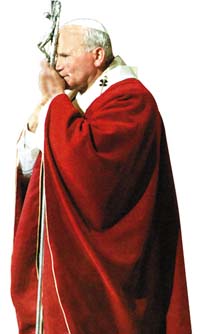
St. John Paul II sanctuary in
Krakow
Krakow churches
Krakow numerous churches are architectural gems, art
hoards, and spiritual hubs
Map of Krakow
Wadowice, the birthplace of Pope John Paul II
Czestochowa
Jasna Gora Sanctuary in Czestochowa is the holiest
place of Poland and one of the world’s most important
destinations for pilgrims.
Kalwaria
With its 42 Baroque churches and chapels of all shapes
and sizes in addition to the central basilica and the Franciscan
monastery, the Kalwaria Zebrzydowska sanctuary is Europe's
biggest Calvary shrine.
Skalka Sanctuary
Poland’s second holiest shrine at the site of St.
Stanislav’s 1079 martyrdom. Splendid Baroque church and fine
monastery modeled on a Renaissance castle.
Sanctuary of the
Lord's Mercy
Humble nun’s visions in the 1930s gave rise to a
world-wide spiritual movement inside the Catholic Church, ever
stronger nowadays, with the center in her Krakow convent.
Roman Catholic
Church
Sunday Masses
The 2006 visit of Pope Benedict XVI to Krakow Pope
Francis to visit Krakow in 2016 |