|
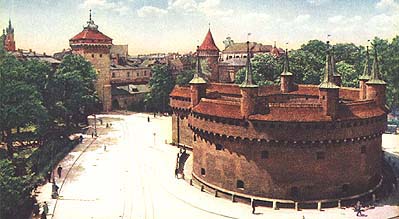
Medieval Fortifications of Krakow
Medieval Krakow had round it two-mile-long walls with 39
towers and 8 gates. Their construction began in the late
13th century. The city walls proper were as high as ten
meters and 2.5-meter thick. Alongside them additional lower
walls ran. And an eight-meter-deep and 22-meter-wide moat
protected both.
In the first decades of the 19th century Krakow's imposing
if outdated fortifications were largely pulled down.
Fortunately, the main city gate called Brama Florianska
survived together with three adjacent towers, the walls
between them, the 16th-century city arsenal, and a giant
barbican
in front of them all.
Brama Florianska, the main gate of the medieval Krakow
The Brama Florianska gate, built about 1300 as a rectangular
Gothic tower of wild stone, is 33.5 m tall. In the Middle
Ages the Krakow furriers defended it. Its present baroque
roof dates from 1694 and a big 16th-century bas-relief of
St. Florian adorns the south wall. The famed 19th-century
painter Jan Matejko designed a stone eagle on the other side
of the gate tower. At the Brama Florianska gate Krakow's
Royal Road
begins. Here entered kings and princes, foreign envoys and
guests of distinction, coronation processions and other
parades, to move up the Florianska Street to the
central Grand Square (Rynek Glowny),
and further down the Grodzka Street to the
Wawel Royal Castle.
Tour of the Krakow fortifications
From April through October
visitors may tour the Brama Florianska gate tower and the
adjacent medieval fortifications every day from 10:30 a.m.
to 6 p.m. Entrance for the sightseers is situated in the
Baszta Pasamonikow tower at the eastern end of Pijarska
street at Szpitalna street. The 180-meter tour runs through
a parapet walk via the neo-Gothic upstairs chapel of the
Brama Florianska gate to the Brama Stolarska tower and it
also includes the
barbican (Barbakan). A normal ticket is eight
zlotys.
Wawel Royal Castle
Home to three dynasties of Poland's monarchs. Its
stately halls and exquisite chambers are filled with priceless
art, best period furniture and rare ancient objects. The
collection of the 16th-century monumental Flemish tapestries is matchless.
Wawel Cathedral
Poland's impressive national shrine shelters plenty of
superb church art. Its giant bell of 1520 ranks with the
world's largest. Most Polish kings and their family members are
buried in the cathedral, its chapels and crypts.
Grand Square
Krakow’s central Grand Square (Rynek Glowny), the
largest plaza of medieval Europe and one of the world’s finest
with its spectacular landmarks, has remained the hub of the city
since the 13th century.
Basilica of the Virgin Mary's
The immense Gothic church, Krakow's principal temple
since the 13th century, shelters the world's greatest Gothic sculpture among its many excellent works of art
Cloth Hall
The world's oldest shopping mall has been in business
for 700 years. The present Renaissance edifice dates from 1555.
Town Hall Tower
Krakow's leaning tower was built by the end of the 13th
century.
Great Barbican
Awesome 500-year-old unmatched masterpiece of medieval
military engineering
Planty Garden Ring
Park of 30 varied gardens among old trees round
Krakow's Old Town historical district
Collegium Maius
15th-century impressive Grand College of the Krakow
university where Copernicus once studied.
Krakow mummies
Picturesque 17th-century church and monastery shelter
numerous naturally mummified bodies in their crypts.
Kanonicza Street
The most beautiful of Europe's ancient streets,
arguably.
|