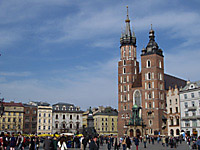
Round the Rynek Glowny Central Square of Krakow's Old
Town.
All Krakow roads lead to the city’s central
Grand Square (Rynek Glowny) which proves to be one of
its greatest attractions for the residents and the visitors
alike.
The 13th-century Gothic
basilica of the Virgin Mary’s (Bazylika
Mariacka) towers above the huge plaza. It’s a must to enter
and see Veit Stoss’ great altarpiece, the 15th-century
masterpiece of monumental sculpture. The smaller 1338
St. Barbara’s church right behind the basilica used to be a
mortuary first.
Farther clockwise round the Grand Square, at the Sienna
Street corner, one finds a large gray building (Szara
Kamienica) dating back to the 13th century which
got its Renaissance form in the 16th century. The adjacent
house of 1561 at 7 Grand Square served as Poland’s first
post office in the 16th and the 17th centuries. The
16th-century house at no. 9 is topped with an ornate 9-meter
attic with relief statues of circa 1560. The first pharmacy
in the House Under a Golden Head at no. 13, now turned into
a shopping arcade, opened in 1408.
The ground floor of the stately Hetmanska building at 17
Grand Square contains one of Krakow’s oldest interiors, the
14th-century Gothic great hall (now a restaurant).
The 1718 fresco Madonna adorns the front of the 16-century
House Under Picture at no. 19. It adjoins an aristocratic
palace at no. 20 of the 16th-century Renaissance turned the
17th-century Baroque and neo-classic since 1783 with a Louis
XVI facade.
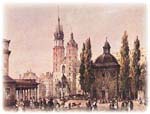
More nobility palaces one finds on the Grand Square’s
western side at no. 27 (Pod Baranami), no. 30, no. 34, and
no. 35 (Palac Pod Krzysztoforami, i.e. “Under St.
Christopher”). The first one dates back to the 16th century
and was thoroughly rebuilt in 1860 (its cellar is home to
the cult Pod Baranami cabaret company since 1956). The last
one was erected in 1640 as an opulent Baroque residence of
the 17th-century richest Polish aristocrat and now it
shelters the City of Krakow Historical Museum. 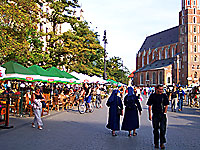
The ground floor cafe at 38 Rynek Glowny grand square, on its northern
side, was established in 1832 and remains the city’s oldest.
The corner house at no. 42 was build as the 16th-century
Renaissance palatial residence for one Jan Boner, a
patrician banker of three Polish kings, and rebuilt as a
neo-renaissance bourgeois residence house in 1878. The
16th-century House Under Eagle (Pod Orlem) at 45 Grand
Square boasts a rare gothic-renaissance facade of red brick.
The ornate rococo facade of the last building in the row,
the Margrave’s House (Kamienica Margrabska), dates back to
the 18th century.
Restaurants
near the Krakow Rynek central square.
Any following information has been provided by respective
restaurants on their sole responsibility.
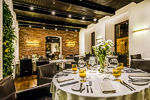
Albertina Restaurant & Wine
Polish cuisine with Mediterranean twist.
Address: ul. Dominikanska 3, 31-043 Krakow (located in the
center on the corner of Dominikanska and Poselska streets).
Phone: +48 123334110, mobile + 48
570136720, Website
www.albertinarestaurant.pl
www.facebook.com/AlbertinaRestaurant
Albertina is an exceptional place on
the culinary map of Krakow. The restaurant, located in the
center of the Old Town, tempts with a unique character of its
decor, carefully prepared menu, and excellent wine selection
from all over the world. Albertina combines Polish cuisine in
modern form, based on seasonal menu and local products, with
Mediterranean inspirations, e.g. fresh lobsters and oysters from
its own lobster tank (the only one in the entire Krakow). Also,
Albertina can boast Poland's only Enomatic system of
self-service wine dispensers, with a superb range of 32 wines to
buy by the glass.
Stodola
Polish cuisine.
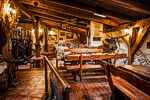
We cordially invite you to our restaurant
located in the heart of Krakow’s old town. The unique
atmosphere, unforgettable style, and true quality have been
appreciated by our satisfied guests. Our menu is rich and
varied, you can choose from tasty meals, good beer, and
delicious drinks. The chef’s specialty is game. By visiting us
you will be convinced that “Stodola 47” is an excellent venue
for a meeting with friends and family as well as any event such
as wedding, birthday parties, etc. Our restaurant can
accommodate up to 90 persons and is open from noon. Visit us and
enjoy.
Address: ul. Florianska 47
Phone: (+48) 122924925
Website: www.stodola47.pl
Grand Square
Krakow’s central Grand Square, the largest plaza of
medieval Europe and one of the world’s finest with its
spectacular landmarks, has remained the hub of the city since
the 13th century. Krakow residents and visitors come here to
meet each other, to do business, to shop, and to enjoy
themselves.
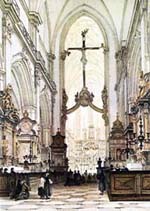
Basilica of the
Virgin Mary's
The immense Gothic church, Krakow's principal temple
since the 13th century, shelters the world's greatest Gothic
sculpture among its many excellent works of art.
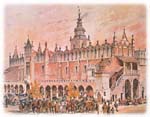
Cloth Hall
The world's oldest shopping mall has been in business
for 700 years. The present Renaissance edifice dates from 1555.
Town Hall Tower
Krakow's leaning tower was built by the end of the 13th
century.
The Crown
Royal giant headdress tops the city of Krakow since
1666
Signal Trump
Hourly musical show in the sky dates from the Middle
Ages
Krakow walks
The best way to enjoy old Krakow is afoot.
Stroll through Krakow's Kazimierz
District
Stroll Up the
Royal Road
In the footsteps
of Pope John Paul II
|