|

 Krakow Info home page Krakow Info home page
Krakow
for mobile
devices
facts
joys
sights
events
musts
hubs
business
food
hotels
travel
buys
tips
Your
Questions
Answered
|
Stroll through the historic Kazimierz area in Krakow
A ten minutes’ walk from the tourists-swarmed Royal Wawel Castle one discovers the
forgotten grandeur and impressive landmarks of Kazimierz, once Krakow’s medieval
twin town, founded by King Kazimierz (Casimir) the Great in
1335. And its former Jewish quarter boasts both restored
synagogues
and energetic
nightlife, courtesy of mushrooming
clubs,
cafes,
bars, and
restaurants.
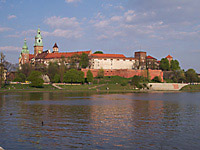
Wawel Hill with the
Royal Castle
The busy Stradom street leads straight from the
Castle’s foot to the Krakowska street, the backbone
thoroughfare of the Kazimierz district.
|
Kazimierz video
Krakow on Foot
The best way to enjoy old Krakow is afoot.
Stroll Up the Royal Road
Stroll Round the
Grand Square
Kazimierz Town
Jewish Quarter
Krakow synagogues
Old Synagogue
Map
of the Kazimierz District
Map of Krakow
Getting around Krakow
|
|
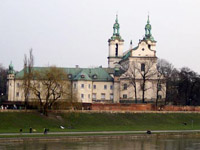
The Skalka sanctuary
Halfway the latter turn right, walk the
short Skałeczna street to the very end and find the quiet Skalka sanctuary, this country’s holiest
place save Czestochowa. Here St. Stanislav,
Poland’s chief patron saint, suffered martyrdom at the hands
of King Boleslav II the Bold in 1079. The 17th-century
Paulinite monastery in the form of a Renaissance castle
adjoins the 18th-century Rococo-Baroque church whose crypt
was turned into a mausoleum of great artists in 1880.
|
|
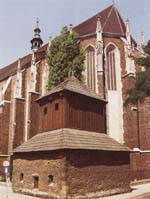
church of St. Catherine’s
On return one passes the arch of an
overhead gallery of 1728 which connects a convent on the one
side of the Skaleczna street with the tall Gothic church of St. Catherine’s (built 1363) on the
other. Round the corner the majestic cloister of the
14th-century Augustinite monastery with splendid medieval
and Renaissance frescos adjoins the church. Back at the main
Krakowska street turn right and after a minute’s walk you
reach the Wolnica Pl., once the central square of the city
of Kazimierz. Its Renaissance Town Hall, dating back to
1528, houses the Museum of Ethnography nowadays. The massive Gothic church of Corpus Christi (ca 1340), with the adjacent monastery,
towers over the northern corner of the square. The church
boasts rich interior (e.g. remarkable stalls of 1629, the
altarpiece of 1634, and the ornate mid-18th-century pulpit).
The Bozego Ciala street in its front leads to the Miodowa
street where after turning right you find the
Moresque-Renaissance Tempel Progressive Synagogue of 1862,
still in service these days.
|
|
One block down the Miodowa street the old
brick wall of the 16th-century R’emuh Cemetery marks the
limits of the ancient
Jewish quarter in the city of Kazimierz. The next turn right
takes you to the Szeroka street, once the central square of
the Kazimierz Jewish Town, the capital of Poland’s Jews from
the 16th century through the 19th century. At the square’s
northern end one passes by the Dom Jordanow, the
16th-century mansion of Polish noblemen–it was incorporated
into the Jewish quarter by the 18th century.
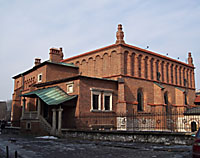
Old Synagogue
The opposite
end of the Szeroka street, where king Jan I Olbracht
resettled Jews from Kraków in 1495, is taken up by the
Renaissance Old Synagogue of 1570, housing the Museum of Judaism nowadays. It adjoins the remnants of the
14th-century Kazimierz city walls. In 1557 the Renaissance
tiny R’emuh Synagogue at 40 Szeroka street was built next to
the R’emuh burial ground. And the 17th-century Baroque
building of the former Popper Synagogue still stands at 16
Szeroka street.
|
|
Wawel Hill
Wawel Hill in Krakow, the mecca of every Pole and a
must for foreign tourists, is a microcosm of Polish history and
culture.
Krakow Old Town
Historic District
Poland's prime tourist attraction and a must-see in
Central Europe boasts numerous world-class monuments, charming
vistas, delightful atmosphere, and the best restaurants.
|
|
