|
Krakow is Poland’s second largest city and the country’s
main tourist destination. The local economy is fueled mostly
by expanding service sector although diverse industry and
production still provide a fairly significant portion of
jobs and wealth. The city remains the culture capital of
Poland and its seven universities and nearly
twenty other institutions of higher learning make Krakow the
country’s principal center of science and education.
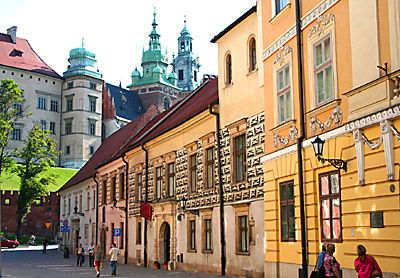
Kanonicza street
in Krakow with the Wawel Royal Castle in the background.
Geography of Krakow, Poland.
The city is situated in
southern Poland on both banks of Wisla (Vistula) river.
Geographic coordinates of central Krakow are 50°04'N
19°56'E. Its average elevation is about 220 meters above sea
level. There are several hills within the city limits,
highest Sowiniec 384 m above sea level.
Krakow has area of 326.8
square kilometers that constitute 0.1 percent of the
territory of Poland.
 The
Krakow companion guide
The
Krakow companion guide
Population of Krakow.
Number of permanent
residents of Krakow proper hovers around 755,000 while the
Krakow conurbation totals some 1.5 million. The local
populace is ethnically almost homogeneous with people
proudly declaring their Polish nationality. Yet immigrants
start to leave a mark on the city, and some expatriate
communities, notably Britons prove themselves quite vocal.
Krakow’s best known historic landmarks.
The city boasts hundreds of
historical buildings, from medieval churches to
Art Nouveau edifices. Krakow’s most popular ancient
monuments are
Wawel Royal Castle (Zamek Krolewski na Wawelu),
Wawel Cathedral (Katedra Wawelska), St. Mary’s church (Kosciol
Mariacki), Collegium Maius, Cloth Hall (Sukiennice),
Barbican (Barbakan), St. Florian Gate (Brama Florianska),
Tyniec Abbey (Opactwo Tynieckie), and Old Synagogue (Stara
Boznica).
Krakow Museums.
There are 36
museums in Krakow including separate branches of
the National Museum in Krakow and the City of Krakow
Historical Museum. Krakow National Museum with its ten
branches and two libraries is Poland’s biggest. Most
interesting museums in Krakow are
The Czartoryskis Museum (Muzeum
Ksiazat Czartoryskis), Royal Castle (Zamek Krolewski),
Schindler's
Factory, Bishop Ciolek Palace (Palac Biskupa Ciolka) exhibiting
medieval art, Museum of Archeology (Muzeum Archeologiczne),
and Aviation Museum (Muzeum Lotnictwa).
Entertainment in Krakow.
Concerts of classical music,
jazz, and pop take place every day in Krakow and especially
on weekends there is wide choice of them. The city’s is
famed in Poland for its energetic nightlife, courtesy of
hundreds of nightclubs. Krakow’s seven repertory theaters as
well as a plethora of independent companies stage plays in
Polish. Krakow Opera Company performs two or three times a
week except for the summer break from early July to late
September. Ballet and other dance shows usually take place
once a week or even less frequently.
See
calendar of concerts and other events in Krakow.
Food in Krakow.
The city can boast several hundred restaurants and over
thousand other eateries from fast food joints to sushi bars.
Good restaurants in Krakow are concentrated in
the Old Town historic center, also nearby Kazimierz
district. Most restaurant menus reflect international diet
adapted to the country’s culinary tradition. Otherwise,
despite deep inroads of foreign cuisines, Polish-style
cooking prevails.
The oldest man-made
artifacts excavated in Krakow date from early Stone Age,
namely the Paleolithic period, some 200,000 years ago.
Archeological evidence from ensuing ages proves that the
place has been a major regional center since the Neolithic
period 6,000 BC. Circa 990 Krakow, then already a thriving
city, was incorporated into the emerging Polish state. In
1038 Krakow became the capital of Poland. In 1257 Prince
Boleslav the Shy endowed the city with self-government and
vital commercial privileges. Krakow formally remained the
capital city of the Kingdom of Poland till the turn of the
18th century, but in fact the political center had moved to
Warsaw in 1611. In years 1815 to 1846 Krakow constituted,
together with its environs, an independent statelet called
Krakow Republic, subsequently annexed to the Austrian
Empire. By the end of the 19th century Krakow became the
center of the Polish national awakening and in 1918 it was
Poland’s first city that regained independence from foreign
rule.
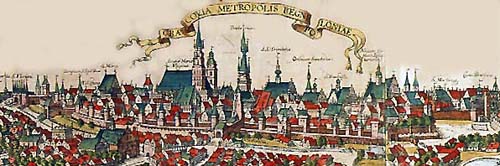
View of Krakow
published in 1617. The Old Town's skyline changed little
since then.
It’s Krakow, Poland. Forget
Cracow, Krackow, Crakow, Krakov and the like.
The original Polish spelling
of the name of the city is Kraków, pronounced ‘krakoof’.
Standard English spelling is
Krakow even if the dated version ‘Cracow’ – tainted by the
borrowing from the French who call the city ‘Cracovie’ –
happens to some speakers of English, including natives of
Krakow. Other forms such as Krackow, Crakow, Cracov, and
Krakov are patently incorrect.
Actual origin of the name ‘Kraków’
is lost in the mists of proto-history. Its form suggest a
‘the place of Krak’, i.e. a town founded or owned by some
Krak, so “Krakow” may translate as “Krak’s”. It gave rise to
the legend of good Prince Krak who had ruled over Poland
from Krakow.
The first appearance of the
name of Krakow in writing dates back to year 996 when the
city was mentioned in Arab transliteration in a report of
Ibrahim ibn Jacob, a Moor trader who traveled to the Eastern
Europe.
|
Travel to Krakow
By plane, by bus, by train, by
car.
Good hotels in Krakow
Hostels in Krakow and other low-cost accommodation
Rental holiday apartments in Krakow
Where to eat out in Krakow
Shopping in Krakow
Krakow
tours and day-trips
Touring
the city and the Malopolska region.
Real
estate in Krakow
|