|
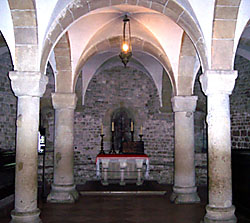
St. Leonard's crypt dates from the 11th century.
Royal tombs of the Wawel Cathedral in
Krakow
Whereas Poland's medieval monarchs were buried under the
floor of the Wawel Cathedral below their sarcophagi,
those of the l6th, the 17th and the 18th centuries were laid
to rest in its crypts. That innovation, too, was introduced
by King Sigismund I the Old. In 1533 he transferred the body
of his first wife to a purpose-built vault underneath the
brand-new exquisite chapel named after him later on. He
joined her in 1548.
Most crypts of the Wawel Cathedral date back to the l6th and
the 17th century and they entomb ten Polish monarchs
together with their spouses and occasionally children. Then
the nation's greatest war heroes were honored with the
burial in the Cathedral's vaults – Prince Jozef Poniatowski
in 1817, Tadeusz Kosciuszko in 1818, Marshal Jozef Pilsudski
in 1935, and General Wladyslaw Sikorski in 1993.
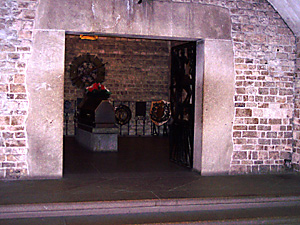
Vestibule of the Marshal Pilsudski
crypt at the Krakow Cathedral.
In 2010 President Lech Kaczynski and his wife Maria were
buried in the vestibule of the Wawel Cathedral's Marshal
Pilsudski crypt, which created considerable controversy at
the time.
The remains of two 19th-century Polish outstanding poets –
Adam Mickiewicz in 1890 and Juliusz Slowacki in 1927 – were
buried in the separate "Bards' Crypt" which contains also a
symbolic tomb of Cyprian Kamil Nowid, another great poet,
and a plaque commemorating Frederic Chopin.
In 1873 royal crypts were connected and made open to the
public. The entrance is on the left of the nave in the first
chapel of the north aisle. The tour of the tombs starts in
the vast 11th-century Crypt of St. Leonard's, considered the
best Romanesque interior in Poland.
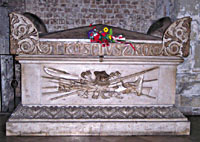
Tadeusz Kosciuszko's sarcophagus
dates from 1818.
Regular ticket price to the WAWEL CATHEDRAL
(plus the Zygmunt Bell and the Royal Tombs)
is an equivalent of about 2.5 euro
Monday-Saturday open to tourists 9.00 a.m. to
4.00 p.m.
On Sundays and Holidays open to tourists 12.30
p.m. to 4.00 p.m.
The Wawel Hill is accessible to visitors daily
May 1 through September from 6.00 a.m. to 8.00
p.m. and since October through April from 6.00
a.m. to 5.00 p.m. The Royal Castle's arcaded
courtyard is off limits half an hour before the
closing time. Exhibitions in the Royal Castle
are closed on Christmas, December 31, January 1,
Easter Sunday and Monday, November 1 and
November 11.
The following are permanent
exhibitions on the Wawel Hill:
State Rooms - historical interiors,
tapestry collection of Sigismund II Augustus,
royal portraits, Italian Renaissance furniture,
Italian and Dutch painting of the 14th to 17th
century.
Royal Private Apartments.
Crown Treasury and Armory
- regalia, jewelry, precious weapons, armors and
caparisons; Polish and West European.
Oriental Art - Turkish tents
and banners, Turkish and Persian weapons and
carpets, Chinese and Japanese ceramics.
The Lost Wawel - archaeological
and architectural reserve of the early
11th-century church of St. St. Felix and
Adauctus' with surroundings; objects excavated
by archeologists on the Wawel Hill; ornate stove
tiles of the 16th and 17th century. Plus
multimedia presentation of the Wawel Hill's
history.
Dragon's Den - big
cave said to be the fiery monster's
hideout.
Admission terms and fees might be
subject to changes. For inquiries and booking
please contact the Tourist Service Office (BOT),
Wawel 5, 31-001 Kraków, Poland, tel.: (+48 12)
4225155 ext. 291, tel./fax: (+48 12) 4221697
|
|
Krakow in Poland
Wawel Hill
Wawel Hill in Krakow, the mecca of every Pole and a
must for foreign tourists, is a microcosm of Polish history
and culture.
Wawel Cathedral
Poland's impressive national shrine shelters plenty of
superb church art.
Wawel Royal Castle
Home to three dynasties of Poland's monarchs. Its
stately halls and exquisite chambers are filled with priceless
art, best period furniture and rare ancient objects. The
collection of the 16th-century monumental Flemish tapestries is
matchless.
Sigismund Chapel
The pearl of Renaissance architecture and art.
Every inch of its ideally proportioned stone walls and dome is
covered with fine sculptures..
Great Bell
Giant Zygmunt bell is a third heavier and 350 years
older than its famed London cousin, the Big Ben.
Black Christ's Crucifix
650-year-old, 13-foot-tall remarkable sculpture of the
Savior provided guidance to Queen-Saint Jadwiga in the 14th
century and has heard prayers of the faithful ever since.
|