|
Most Important Dates in the History of Krakow
8th century – Wislanie tribe set up their state with Krakow as
its capital
999 – Krakow province incorporated into the House of Piasts’
realm
1000 – Krakow got its own bishop
1038 – King Casimir I the Renovator moved Poland’s capital to
Krakow
1241 – Krakow demolished by Mongols
1257 – Duke Boleslaw the Shy endowed
Krakow with self-government and trade privileges
1311 – mutiny of Krakow burghers mercilessly squashed by Prince
Vladislav the Short
1320 – coronation of King Vladislav I the Short, first such
event in Krakow’s Wawel Cathedral
1335 – King Casmir III the Great founded his brand-new city of
Kazimierz near Krakow
1364 – King Casmir III the Great founded the
Krakow university
1364 – Krakow summit of European monarchs
1386 – Krakow wedding of Poland’s queen Jadwiga and Lithuania’s
grand duke Jagiello paves the way to the union of the two
nations
1400 – renewal of the Krakow university
thanks to the legacy of the Saint Queen Jadwiga
1447 – the beginning of the 45-year reign of King Casimir IV
that make Poland one of the greatest European powers
1489 – Veit Stoss finished his stunning altarpiece for Krakow’s basilica of Virgin Mary's
1500 – start of the Renaissance renovation of the Wawel Royal Castle
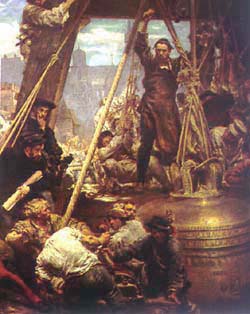
Jan Matejko
painting of 1874 depicts the famous Zygmunt
bell being raised to
the belfry of the Krakow cathedral in 1521.
1558 – regular mail-coach connection established between Krakow
and Venice
1525 – the first prince of newly born Prussia paid homage to
Poland’s King Sigismund I the Old on Krakow’s
Grand Square (see picture above)
1574 – Henry I Valois, the first of Poland’s elective kings, ran
away from Krakow after a 4-month reign to become France’s Henry
III in Paris
1587 – Maximillian Hapsburg’s failed 6-week siege of Krakow made
him drop his bid for the Polish throne
1609 – King Sigismund III Vasa moved his residence to Warsaw
1655 – Swedish army captured and devastated Krakow
1683 – King John III Sobieski led his Polish army from Krakow to
Vienna, won it from besieging Turks, saved Christian Europe, and
brought back booty now displayed in Krakow museums
1702-11 – Krakow was being captured and recaptured, on and on,
and thus ruined by Swedish, German, Polish and Russian troops in
the course of the Northern War
1734 – coronation of King August III, the last one in Krakow’s
Wawel Cathedral
1768 – Krakow became a center of the first Polish uprising
suppressed by Russian troops
1772-78 – Russian occupation of Krakow
1791 – Krakow enlarged by two adjacent towns, Kazimierz and Kleparz, plus settlements
around the city
1793 – another Russian occupation of Krakow
1794 – Krakow was the center of national uprising led by
Thaddeus Kosciuszko
1794 – Prussian army captured Krakow and stole Poland’s regalia
that have been lost forever
1796-1809 – Austrians occupied Krakow
1809 – Krakow incorporated into the Duchy of Warsaw under the
sway of France’s Napoleon I
1813-15 – another Russian occupation of Krakow
1815 – the Congress of Vienna created a tiny, independent
Republic of Krakow
1816 – Krakow Scientific Society was launched, turned the
Science Academy in 1872
1844 – construction of the Krakow-Myslowice railway
1846 – 9-day Krakow Revolution and subsequent Austrian
annexation of the Krakow Republic
1848 – Second Krakow Revolution, Austrian bombardment of the
city
1850 – 10-day fierce fire destroyed a quarter of Krakow
1866 – Vienna let Krakow to enjoy municipal self-government
1879 –
Krakow National Museum, Poland’s best
collection of art, was launched
1883 – a pair of Krakow’s university professors, Karol Olszewski
and Zygmunt Wroblewski, achieved first ever liquefaction of
oxygen, nitrogen and carbon dioxide
1884 – Krakow got its first telephone lines
1893 – Krakow’s renowned city theater moves to its brand-new,
state-of-the-art building
1901 – Krakow got electric tramway (a year ahead of Vienna)
1910 – Krakow’s rapid territorial expansion began
1912 – Krakow’s first movie house opens
1914 – Polish Legions, a nucleus of future Polish army, were
formed in Krakow by Jozef Pilsudski, Poland’s future head of
state
1918 – Krakow was the first piece of the reborn free Poland when
Polish authorities took control of the city by the end of
October
1926 – the Krakow radio station went on air
1939 – the nazi Third Reich and the communist Soviet Union
divided Poland between them and the former set up so called
General Governorship with Krakow as its capital city.
1942 – the German authorities set up
Plaszow concentration camp in Krakow.
1943 – the nazis definitively liquidate the
Jewish ghetto in Krakow on March 14th.
1945 – the Soviet Red Army captured Krakow in January
1949 – giant steelworks built near Krakow with the adjoining
Nowa Huta residential district
1979 – Krakow archbishop Karol Wojtyla became Pope John Paul II and visited his native
city
1980 - workers went on strike at the Nowa Huta steelworks, which
helped to start the Solidarity trade union
1989 – collapse of communism in Poland
1991 – the first democratic elections to the local government
since 1939
|