Krakow’s Pope John Paul II Cathedral Museum
Priceless ancient items from the treasury of
Krakow’s Wawel Cathedral are displayed in the
14th-century Gothic buildings opposite the main entry to the
church. The Cathedral Museum was opened in 1978 by then
Cardinal Karol Wojtyla, future Pope John Paul II, just
weeks before the historic conclave that would begin his
pontificate.
Museum’s collections.
The little Cathedral Museum (Muzeum Katedralne) boasts an
array of exhibits that may be the envy of any collection of
medieval church art in the world. “Kmita’s
Chasuble” of 1503, the masterwork of Gothic
embroidery (see the picture), is just one of them. The
museum’s other gems include ornate golden monstrances and
varied liturgical vessels such as fine chalices and ampullas,
precious ancient crosses, fancy reliquaries, lavish
chasubles and other vestments from the 15th century to the
19th century such as copes and miters, plus old paintings
and sculptures.
A distinct group of exhibits consists of the regalia of
Polish monarchs (in that number copies of items found in
Wawel Cathedral’s royal tombs)
and assorted memorabilia connected with the great Poles,
from the medieval saints to historical Krakow bishops to
Pope John Paul II.
Temporary shows in Krakow’s Cathedral Museum complement its
permanent exhibitions.
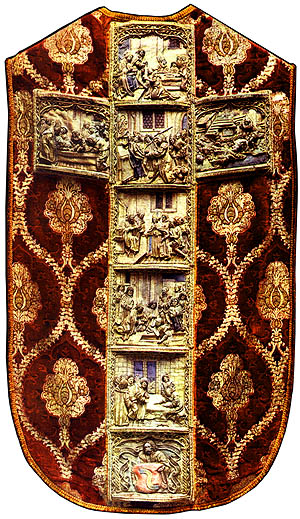
Krakow's 500-year-old 'Kmita's
chasuble', a masterpieces of Gothic needlework, is one
of the most treasured exhibits in the Wawel Cathedral's
museum.
Cathedral Museum’s crown jewels.
For various reasons the following curios deserve special
attention:
-
A golden cross made of two Romanesque coronets with
mysterious ornaments. The coronets, possibly of the 13th
century, tradition associates with Poland’s duke
Boleslav V the Shy (1226-1279) and his saintly wife,
Blessed Kinga (1224-92). The diadems were joined to form
the cross in the late 15th century.
-
St. Hedwig’s goblet. Tradition associates the precious
glass of the 11th-century Fatimid make (Egypt) with
Princess Hedwig of Silesia (Polish name Jadwiga, born
circa 1174 died 1243), the saintly wife of Poland’s
ruler Henryk Brodaty (Duke Henry the Bearded).
-
Coronation mantle of King Stanislav August (1732-1798),
Poland’s last monarch who abdicated in 1795.
-
The 12th-century silver casket made by a Saracen
silversmith on Sicily. Decorated with Arabic
inscriptions as well as embossed scenes of fighting
knights and a medieval hunt, it nevertheless served long
as a church reliquary.
-
St. Stanislav’s miter decorated with pearls,
sapphires, and rubies and his ring. Tradition associates
them with Krakow’s bishop-martyr killed in 1079 though
experts believe both items date from the mid-13th
century.
-
King Sigismund II August’s ornate sword of the 16th
century ceremoniously broken twice at his funeral.
Yet two most prized objects from the cathedral treasure are
missing from the exhibition in the museum. One is the Spear
of St. Maurice (actually a 10th-century copy of Vienna’s
original), given to Poland’s monarch Boleslav I the Brave by
Emperor Otto III in year 1000 as a friendship token. The
other is a golden reliquary of 1506 for the skull of St.
Stanislav, richly decorated with precious stones and adorned
with beautifully carved scenes from the life of the saint
bishop - a masterpiece of the Gothic goldsmithery that
seldom leaves the safe.
The museum is open Monday through Saturday from 9 a.m. to 5
pm April through October and to 4
pm November through March. Regular ticket price amounts to
twelve zlotys, i.e. an
equivalent of under three euro, and it allows to see also
the Wawel Cathedral, the royal tombs in its crypts, and the
giant Zygmunt bell.
Cathedral Museum’s postal address is Muzeum Katedralne im.
Jana Pawla II, Wawel 3, 31-001 Krakow, Poland. Phone (+48)
124222643. |
Krakow
The city that is Poland's prime tourist attraction
and a must-see in Central Europe.
Krakow Old Town
historic area
Wawel Cathedral
Krakow Museums
Fine arts in
Krakow
Krakow galleries
Travel to Krakow
Krakow hotels
|