|
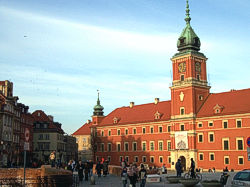
Warsaw, Poland's capital city 300 kilometers from Krakow.
Poland’s capital is also its biggest city and principal
business center. Since the Nazis razed it methodically in
1944, downtown Warsaw lacks historical monuments and its
landmarks are of either postwar construction or postwar
reconstruction, the Old Town and the Royal Castle in the
first place. As the capital city, Warsaw boasts an array of
National culture institutions – The National Opera, The
National Theater, The National Library, etc – and vies with
Krakow for cultural preeminence. There are also
admirable restaurants and vigorous
nightlife.
14th-century founded, Warsaw arrived rather late on Poland’s
map. Yet, as the country expanded north and east in the 15th
century, the once humble peripheral town gained central location
and soon became commercial and political hub. In 1609, when the
Krakow Royal Castle needed repair after a fire,
King Sigismund III moved his residence temporarily to Warsaw,
which proved permanent. In 1791 the city was at last officially
sanctioned as the capital of Poland. When the heroic 1944 Warsaw
Uprising against the overwhelming Nazi forces failed, they took
their revenge and demolished the city block after block.
Warsaw features
Vistula (Wisla) river, the same that flows through
Krakow, divides the 1.8-milion Warsaw in two. The eastern
right-bank part called Praga
has no major tourist attractions. The city center lies on the
left bank, with the rebuilt historical Old Town to the north and
main government and embassy district to the south. While
Stalin-era edifices mark downtown Warsaw, prefab-concrete blocks
of flats mar the suburbs. Mushrooming corporate towers has made
Warsaw the second construction site in the Central Europe after
Berlin in the 21st century.
Main tourist sights of Warsaw
The
Old Town’s reconstruction, from 1949 through 1963, tried to restore its
architectural best from the 17th and 18th centuries, and most
visitors find the result enchanting. The historical district
surrounds atmospheric central square with open-air cafés and art
stalls. The Warsaw Historical Museum occupies its northern side
displaying collections from the city’s earlier history and
documents of the World War 2 tragedy. Royal Castle on the rim of
the Old Town was rebuilt from foundations up in the years
1971 through 1980. The massive edifice has taken the shape the former
residence of both Poland’s elected monarchs and its powerful
parliaments acquired in the late 18th-century refurbishment. The
state halls and royal apartments have been meticulously redone
and, filled with period furniture and art, opened to the public.
Royal Route, running from the Royal Castle south to the Polish
last monarch’s summer residence in Lazienki Palace, is lined
with churches, palaces, museums, galleries, and government
buildings. Turning left at the first traffic circle one finds
the National Museum with an excellent accumulation of Polish
art, medieval through contemporary, and a unique collection of
early Christian frescos from the Polish-excavated cathedral in
Sudan’s Pharos besides an amazing display of Coptic crosses.
Farther south, on an island in vast Lazienki Park, is the
18th-century exquisite Classic Palace on the Water. Still
farther south is another and older royal summer residence amid
fine park–the 17th-century Versailles-like Baroque Wilanow
Palace.
Warsaw’s most outstanding landmark, literally, is the
230-meter-tall Stalin-era Palace of Culture and Science
in the city center, ugly and pretentious, yet specious enough to
shelter innumerable offices as well as 3 theaters, Poland’s
biggest Congress Hall, 2 museums, a playhouse, and trade-fair
facilities. And there is a viewing gallery on top of it.
Food in Warsaw
An array of places all over the Old Town serves Polish and
international food.
Good restaurants
are found in other parts of the city too. Notably ethnic cuisine
outlets–from Vietnamese to Italian–have mushroomed in the recent
years. And a downtown hotel restaurant is a safe bet.
Krakow and Warsaw are linked by shuttle express
trains
that reach either destination in under three hours, no stops
in between. Besides, as Poland's capital, Warsaw is a busy
transport hub for airlines, trains and buses, domestic and
international. The main railroad station – Warszawa Centralna
– is placed in the very city center, next to the towering
Palace of Culture and Science. Warsaw international and
domestic Okecie
airport
is some 10 kilometers southwest from it.
|
Krakow tours and day trips
Poland
nation, geography, climate, wildlife, visitors,
currency.
Poland's history
More data
Poland map
Krakow
Poland's prime tourist attraction and a must in Central
Europe boasts numerous world-class monuments, charming vistas,
delightful atmosphere, and the best restaurants.
In the proximity
of Krakow
Krakow is Poland's tourist mecca, and also a gateway to
many other must-see sites in the region.
Malopolska
Province
Travel to Krakow
There are over 26,000 beds one may choose from.
Good restaurants in Krakow
|