The Krakow Cistercian Abbey of Mogila
Mogila monastery, eight kilometers east of the
Krakow royal castle, has remained the heart of
the Cistercian order in Poland for nearly eight centuries.
At the same time it has been a vital religious center,
crucial to the spiritual life of the whole nation and the
Krakow region in particular.
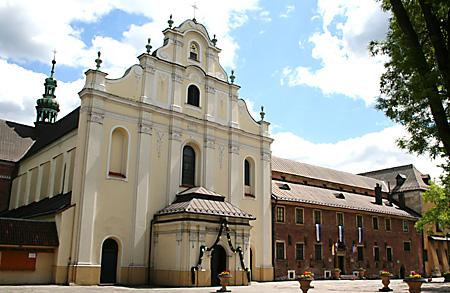
Visiting the Mogila Abbey in Krakow.
Few ancient monuments in
Poland can rival the eight-century-old Mogila Abbey
for the historical value. Yet the Cistercian monastery in
Krakow, the country’s most important, is spared from the
attention of tourists and the place stays pleasantly quiet
apart from the Catholic feasts.
The Mogila Abbey is situated
in Krakow’s eastern
Nowa Huta district and visitors may tour it along
with other attractions in the area, such as ancient Kopiec
Wandy mound, one of the city’s fabled barrows, and the
communist architecture of Nowa Huta.
The abbey is easily
accessible by public transport. There is a bus stop next to
it at Klasztorna street and a tramline runs near by at Jana
Pawla II avenue. Motorists may leave their vehicles on a
little parking lot alongside Klasztorna street.
The Cistercian Abbey of Mogila, points of interest.
Apart from the core church
and monastery the abbey’s compound consists of assorted
buildings that date from various periods. The architecture
doesn’t represent clear-cut styles as subsequent alterations
have left their mark over past centuries. Most prominent
structures are the basilica, monastery around a Gothic
cloister, and the Renaissance abbot’s mansion of 1569.
Church
of the Virgin Mary Assumed to Heaven and St. Vaclav /Kosciol
Najswietszej Marii Panny Wniebowzietej i Sw. Waclawa/.
The church dates back to the 13th century. One of the first
brick buildings in the Malopolska province, it was an
interesting mixture of Romanesque and Gothic features. The
baroque frontal part and facade have been added in 1780,
together with the vault of the nave. The present church
interior reveals austerity typical for early Cistercian
architecture. It is manifest in the chancel closed with a
plain wall and a pair of ‘twin’ chapels on the right. The
Gothic features of the interior include the main altarpiece
of 1514 in the chancel and the 15th-century crucifix in a
chapel on the left behind an iron grille of 1650. The
Renaissance art is represented by Stanislaw Samostrzelnik’s
outstanding frescos in the right-hand transept and one of
the ‘twin’ chapels as well as the painting of circa 1530 on
the forward wall of the chancel. The rest of the decor
mostly dates to the Baroque of the 18th century. In 1970
Pope Paul VI has elevated the church to the rank of a minor
basilica.
Cistercian monastery. The monastery has adjoined the
Church of the Virgin Mary Assumed to Heaven and St. Vaclav
to the south since the 13th century. The oldest parts of the
present quadrilateral structure are the 13th-century cellars
of the west wing and ground floor of the east wing. Ground
floors of the west and the south wings date back to the 14th
century together with the Gothic refectory and cloister.
Abbot's Palace. The Renaissance palace of 1569 abuts
the monastery at its southeast corner. It incorporates the
15th-cenury Prior’s House. The baroque portal dates from the
17th century.
History of the Cistercian abbey in Krakow.
The Mogila Abbey was founded
in 1225 by Krakow bishop Iwo Odrowaz. It was located in the
rural area west of the city, at the fork of the Wisla and
Dlubnia rivers. In the Middle Ages the monastery was known
as Clara Tumba, ‘Clear Tomb’ in Latin, after the
ancient barrow situated less than a mile to the east. Also
the Polish name of the abbey and the adjoining village,
Mogila, translates as ‘tomb’.
The first Mogila monastery
was destroyed by Mongols in 1241. In the 17th century it was
demolished be Swedes who killed all its residents save two
monks.
|
Churches in
Krakow
Krakow Cathedral on the Wawel Hill
Poland's impressive national shrine dates from the 14th
century and shelters plenty of superb church art. The Sigismund Chapel is a masterpiece of the
Renaissance art and architecture. Giant Zygmunt bell of 1520 ranks with the world's largest. Most Polish kings are buried here together with the greatest
national heroes.
Skalka Sanctuary
Poland’s second holiest shrine at the site of St.
Stanislav’s 1079 martyrdom. Splendid Baroque church and fine
monastery modeled on a Renaissance castle.
Tyniec Abbey
Hilltop monastery-fortress dates from the 11th c.
Bielany Monastery
Magnificent 17th-century Baroque hermitage complex atop
the Silver Mountain hovers over Krakow.
St. Norbert's Convent
Vast fortified complex on the Vistula river is home to
Krakow’s once powerful Premonstratensian Sisters since the 12th
c.
Sanctuary of the Lord's Mercy
Humble nun’s visions in the 1930s gave rise to a
world-wide spiritual movement inside the Catholic Church,
ever stronger nowadays, with the center in her Krakow
convent.
Czestochowa
Jasna Gora Sanctuary in Czestochowa is the holiest
place of Poland and one of the world’s most important
destinations for pilgrims.
Kalwaria
Zebrzydowska
With its 42 Baroque churches and chapels of all shapes
and sizes in addition to the central basilica and the Franciscan
monastery, the Kalwaria Zebrzydowska sanctuary is Europe's
biggest Calvary shrine.
In
the footsteps of Pope John Paul II
|