The
greatest artist of medieval Krakow.
Veit Stoss
a.k.a. Wit Stwosz, arguably the best sculptor of the Middle
Ages, lived and worked in the
Polish city of Krakow from 1477 to 1496. Here he
created his supreme masterpiece – huge multiple-part altar
in the church
of the Virgin Mary (Kosciol Mariacki) that towers
over Krakow’s Old Town central historic district. Also a
number of the artist’s other outstanding works grace the
former capital of Poland and thus it can boast more
sculptures by Veit Stoss than any place.
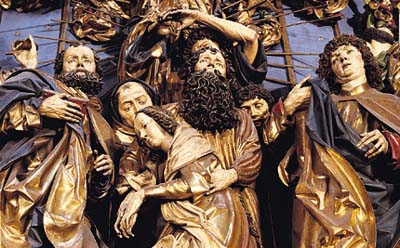
Central scene of St. Mary's altar in the church of the
Virgin Mary in Krakow
consists of three-meter-tall statues of the apostles.
The life of Veit Stoss: between Krakow and Nuremberg.
The artist known also as Wit Stwosz, Veit
Stvos, and Wit Stosz was born in Horb am Neckar in south
Swabia, now southwest Germany, in 1447 or possibly 1448. He
died in the city of Nuremberg in German Franconia on
September 20th, 1533 and was buried at St. Johann's
cemetery.
As a young man Veit Stoss was apprenticed
to Dutch sculptor Nicholas of Leyden who worked in
Strasbourg, Constance, and Vienna at that time. In 1468
Stoss achieved the rank of a master sculptor. He also
traveled Swabia and Rhineland to further his artistic
education. Next Veit Stoss moved to Nuremberg in 1473 where
he married Barbara Hertz and set up a workshop.
In 1477 Veit Stoss arrived to
Krakow in Poland to accept a very lucrative
commission to carve the biggest Gothic altarpiece ever for
the city’s largest church. Curiously, it’s his earliest
known work. In Krakow Veit Stoss set up his own workshop
employing other sculptors as well apprentices and he assumed
a more Polish name of Wit Stwosz. It took him twelve years
to complete St.
Mary’s altar with its 200 sculptures. Subsequent
Krakow’s works by Veit Stoss include statues, tombs,
bas-reliefs, and engravings.
From 1484 Veit Stoss doubled as the
municipal architect of Krakow. In 1486 he left for Nuremberg
and Passau for a year-long studies. Some historians believe
that it resulted in the blueprint for
Krakow’s barbican built in 1499, the largest
medieval fortification of this kind in Europe.
In 1496 Veit Stoss left the family
business in Krakow to son Stanislaw – a successful sculptor,
painter, and goldsmith in his own right – and moved with
wife and eight other children back to Nuremberg. Till his
death 37 years later Veit Stoss managed to execute many
outstanding sculptures throughout southern Germany but none
compares with the high altar in St. Mary’s church in Krakow.
Nuremberg authorities arrested the
sculptor for forgery of a bill of exchange in 1503 and as a
punishment he was branded on both cheeks with a nail.
Note: the artist, known as Wit Stwosz in
Poland and Veit Stoss elsewhere, used to sign his works 'Eit
Stvos'.
Veit Stoss's works in Krakow.
The Altar of St.
Mary's. Completed in 1489, limewood. In the chancel
of the church of the Virgin Mary (Kosciol Mariacki) at Rynek
Glowny central square /entry for tourists at Plac Mariacki
square/.
Crucifix of
circa 1491, stone. In the east end of the south aisle of the
church of the Virgin Mary (Kosciol Mariacki) at Rynek Glowny
central square near the entry for tourists from Plac
Mariacki square.
Sarcophagus of King
Casimir IV of circa 1492, marble. In the
Wawel Cathedral next to the
Royal Castle.
Scene in the Garden
of Gethsemane of circa 1485, bas-relief in sandstone.
The original in
National Museum in Krakow, Bishop Ciolek Palace
branch at 17 Kanonicza street. Copy on the outside wall of a
building at Plac Mariacki square opposite the church of the
Virgin Mary.
Plaque
commemorating Filippo Buonaccorsi a.k.a. Kalimach of
1506, bronze. In the Black Friars' church (Kosciol OO.
Dominikanow), Stolarska street at Dominikanska street.
Drawing of a design
for the altar in Nuremberg's Carmelite church in the
collection of the
Jagiellonian University Museum (Collegium Maius),
15 Jagiellonska street at Sw. Anny street. The altar itself
is in the Bamberg cathedral now.
Sculptures in Krakow attributed to Veit Stoss.
Crucifix on
the rood screen above the nave of the church of the Virgin
Mary (Kosciol Mariacki) at Rynek Glowny central. Some
experts think that Veit Stoss himself carved that beautiful
giant wooden crucifix, some believe it's the work of his son
Stanislaw Stwosz, some maintain the sculpture was just made
in their workshop by other woodcarvers around 1520.
St. Anna with St.
Mary and the baby Jesus in a chapel at the north
aisle of St. Bernard's church (Kosciol OO. Bernardynow) at 2
Bernardynska street.
Scene in the Garden
of Gethsemane by the entrance
to the church of St. Barbara (Kosciol Sw. Barbary) at Plac
Mariacki square. Expert agree that sculptures were made in
the Stoss' workshop but they differ about his involvement.
Two figures of
knights of the 1480s, gilded
wood. Both sculptures were in the possession of the church
of the Virgin Mary, now in the collection of the National
Museum in Krakow.
|