Poland, Detailed Information and
Statistics
Area: 312,685 sq. km of which land 304,465
sq. km and water 8,220 sq. km.
Latitude and longitude: Poland stretches between 49°00’N (Opolonek
mount) and 54°50’N (Rozewie peninsula), and between 14°07’E
(Odra river near the town of Cedynia) and 24°08’E (Bug river
near the town of Strzyzow).
Land boundaries: 2,788 km
of which 658 km with the Czech Republic, 526 km with
Ukraine, 456 km with Germany, 444 km with Slovakia, 407 km
with Belarus, 206 km with Russia’s Kaliningrad enclave, 91
km with Lithuania. Coastline 491 km.
Elevation: lowest -2 m (Raczki Elblaskie), highest 2,499 m
(Mount Rysy in the
Tatry Mountains).
Natural resources: coal, copper, sulfur, natural gas, silver,
lead, salt.
Arable land: 47 percent of which permanent crops 1 percent,
permanent pastures 13 percent, forests and woodland 29 percent,
other 10 percent.
Poland's Population
(2012 est.)
38,415,000 of which male 48.4 percent and female 51.6 percent
(106.5 women for every 100 men). Age: 14.7 percent age 0-14,
71.6 percent age 15-64, 13.7 percent age 65 years and more.
Population growth: minus 0.075 percent yearly. Birth rate: one
birth per 100 inhabitants. Death rate: 1.024 death per 100
inhabitants. Net migration: minus 47 migrants per 100,000
inhabitants. Urban population 61.8 percent, rural 38.2 percent.
Nationality: Polish 96.7 percent, Silesian 0.45, German 0.4
percent, Belarusian 0.13 percent, Ukrainian 0.08 percent.
Legal aliens as
permanent residents: 0.2 percent.
Religion: Roman Catholic 89.8 percent (about 75 percent
practicing), Eastern Orthodox 1.3 percent, Protestant 0.3
percent, other 0.3 percent, unspecified and non-believers 8.3
percent.
Suffrage: universal from age 18.
Infant mortality: 6.42 deaths per 1,000 live births.
Life expectancy at birth: 76.25 years, of which male 72.31
years, female 80.43 years.
Fertility: 131 children per 100 women.
Languages: 97.8 Polish as the native tongue. Literacy: 99.8
percent age 15 and over can read and write.
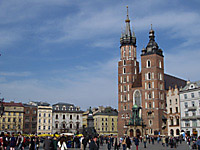
Rynek Glowny central square of
Krakow, Poland.
Poland's Government
President as the head of state, council of ministers chaired by
prime minister as the executive branch, bicameral National
Assembly (the Sejm with 460 deputies and the senate with 100
senators) as the legislative branch. Judicial branch consists of
the Supreme Court, the Constitutional Tribunal, the Chief
Administrative Court, and the local and district courts.
Administrative divisions: 16 provinces (wojewodztwa, singular wojewodztwo)
with local governments – Dolnoslaskie, Kujawsko-Pomorskie, Lodzkie,
Lubelskie, Lubuskie,
Malopolskie,
Mazowieckie, Opolskie, Podkarpackie, Podlaskie, Pomorskie,
Slaskie, Swietokrzyskie, Warminsko-Mazurskie, Wielkopolskie,
Zachodniopomorskie. Capital:
Warsaw.
National holidays: Constitution Day May 3, Independence Day
November 11. Other major holidays: New Year, January 6th,
Easter (Sunday and Monday), May 1st, Whit Sunday, Corpus
Cristi, August 15th, November 1st, and Christmas (i.e.
December 25th and December 26th).
Defense: annual military expenditures at 1.9 percent of GDP,
about 206,000 active troops in Army, Navy, Air and Air Defense
Force, and Special Forces.
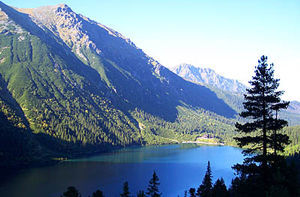
Morskie Oko lake is a
must-see of the Tatry Mountains.
Poland's Economy
Services 63 percent, industry 33.6 percent, agriculture 3.4
percent of GDP.
GDP 1.9 trillion zlotys in 2016. Annual growth rate 4.6
percent in 2017. GDP per capita 15,460 euro (the 2011 estimate,
purchasing power parity).
Inflation was
3.8 percent in 2011.
External debt: 236 billion euro by the end of 2011 (est.)
Budget in 2011:
revenues 74 billion euro,
expenditures 84.8 billion euro. Public debt on the end of
2016 was zlotys 0.929 trillion. Proportion of public debt
to GDP 50.1 percent in 2016.
Labor force: 17.9 million. Unemployment 5,3 percent in February
2017 according to Eurostat.
Average wage: 3,075 Polish zloties (PLN) per month before
tax.
Industries: machinery, iron and steel, coal mining, chemicals,
shipbuilding, food processing, glass, beverages, textiles.
Industrial production growth rate 7 percent in 2011 (est.)
Agriculture: potatoes, fruits, vegetables, wheat; poultry, eggs,
pork, beef, dairy
Exports: 151.5 billion euro (the 2011 estimate) of which
manufactured goods and chemicals 40.8 percent, machinery and
equipment 37.8 percent, food 7.6 percent.
Germany 26.9 percent, France 7.1 percent, UK 6.4 percent,
Italy 6.3 percent, Czech Republic 6.2 percent, Netherlands
4.3 percent.
Imports: 167.7 billion euro (2011 estimate) of which
manufactured goods and chemicals 38 percent, machinery and
equipment 36 percent, mineral fuels and minerals 9 percent, food
8 percent. Germany 29.1 percent,
Russia 8.8 percent, Netherlands 6 percent, Italy 5.8 percent,
China 5.6 percent, France 4.5 percent.
See information on Poland's currency
Transport in Poland
Roads 423,997 kilometers of which 765 km expressways.
Railways 19,428 km. Waterways 3,997 km. Ports and harbors:
Gdansk, Gdynia, Szczecin, Swinoujscie. Airports with paved
runways: 86.
Education in Poland
Free compulsory education for ages 6-19. Free university
education. Literacy: universal among those older than 15
years.
Poland's Participation in International Organizations
Poland has joined the European Union on May 1, 2004. The
country has also been part of the European Union's Schengen
Zone of simplified border controls since December 20, 2007.
Member:
Australia Group, BIS, CBSS, CE, CEI,
CERN, EAPC, EBRD, EIB, EU, FAO, IAEA, IBRD, ICAO, ICC, ICCt,
ICFTU, ICRM, IDA, IFC, IFRCS, IHO, ILO, IMF, IMO, Interpol, IOC,
IOM, ISO, ITU, MIGA, MINURSO, MONUC, NATO, NSG, OECD, OPCW,
OSCE, PCA, UN, UNCTAD, UNDOF, UNESCO, UNHCR, UNIDO, UNIFIL,
UNMEE, UNMIL, UNMIS, UNOCI, UNOMIG, UPU, WCL, WCO, WFTU, WHO,
WIPO, WMO, WToO, WTO, ZC
associate: WEU
observer: ACCT , BSEC, OAS,
guest: NAM,
International Agreements on Environment
Air Pollution, Antarctic-Environmental Protocol,
Antarctic-Marine Living Resources, Antarctic Seals, Antarctic
Treaty, Biodiversity, Climate Change, Climate Change-Kyoto
Protocol, Desertification, Endangered Species, Environmental
Modification, Hazardous Wastes, Kyoto Protocol, Law of the Sea,
Marine Dumping, Ozone Layer Protection, Ship Pollution, Wetlands.
Signed, but not ratified: Air
Pollution-Nitrogen Oxides, Air Pollution-Persistent Organic
Pollutants, Air Pollution-Sulfur 94, ACTA.
|
Poland
nation, geography, climate, wildlife, visitors,
currency.
Poland's history
Krakow
National
holidays in Poland
Poland's map
|