The town is situated roughly halfway between
Krakow and Zakopane. It
lies on both banks of Raba river, in a valley between two ranges of Beskidy
mountains, Gorce and Beskid Wyspowy. Its elevation ranges between 500 meters and
600 meters above sea level.
Rabka Zdroj consist of a downtown area in the
valley and a number of settlements on the lower slopes of Gorce Mountains. The
municipality also includes former villages of Zaryte and Zabornia.
Gorce National Park (Gorczanski Park Narodowy), stretches close to
the southeast border of Rabka Zdroj.
Health resort of Rabka
Rabka’s
hospitals and clinics specialize in the medical treatment of children
with diseases of respiratory tracts, asthma, and diabetes; also adults with
heart condition and circular deficiencies. The spa’s mineral waters and brines
help to heal bronchitis, rhinitis, and the like, to overcome rheumatoid
arthritis, and the generally strengthen the body and reinforce its resistance to
illnesses.
History of Rabka
In the 13th century the village of Rabka
belonged to the Cistercian monastery in Ludzmierz. In 1364 King Casimir III the
Great established it as a royal estate. From the 15th century on it was property
of various landed gentry. Curative properties of Rabka’s brines rich in bromine
and iodine were recognized in 1721. In the 1860s the town began its career as a
popular health resort. In 1953 Rabka has been granted a city charter.
Contemporary Rabka.
Now Rabka Zdroj is a town of 13,000-plus
permanent inhabitants, incorporated as a city. It lies in Powiat Nowotarski
county, part of Wojewodztwo
Malopolskie province whose capital is Krakow.
The local economy is traditionally based on
health services and tourist industry but the town’s small businesses
also venture into other branches of the service sector as well as construction
and the like.
Rabka Zdroj, a mountain resort.
Rabka is an important gateway to Beskid
Mountains for hikers as a number of trails meet in the town. Some of them lead
to Gorce range and its national park, the other to Beskid Wyspowy. Most
interesting treks link Rabka Zdroj with Turbacz peak (red trail, 4h30) and with
Lubon Wielki peak (3 hours, blue trail).
Also, Rabka Zdroj can boasts three decent if modest ski slopes - complete with
lifts, lighting, snow cannons, ski instructors, snowboard and ski rentals, car
parks and cafes.
Recreation
and entertainment in Rabka.
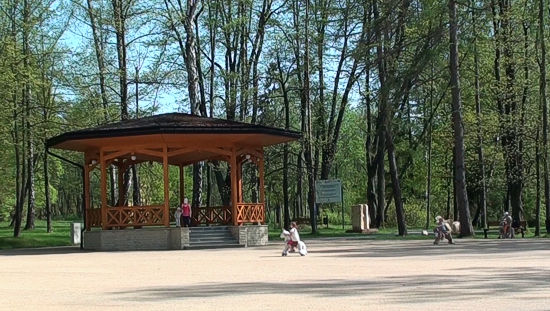
The town’s main recreation area consists of
the central park and its facilities. It contains two adventure playgrounds for
children, a couple of tennis courts, a court for beach volleyball, a skatepark, a fitness
trail, and a band shell for live performances. A graduation tower with a covered
path round it provides air saturated with mineral salts, free of charge, on the
park’s western edge. On summer weekends varied special events and festivities
take place in the park.
Rabka’s other sports facilities are
concentrated on the bank of a stream alongside Jana Pawla II street where an
artificial ice-skate rink (winter only) and a skate park sit next to a stadium
which is home to the local Wierchy soccer team. Also, there is a public open-air
swimming pool in Rabka plus a couple of indoor swimming baths.
Rabka boasts a cinema, a professional puppet
theater that has been very popular with children for decades, and an amusement
park. Concerts take place from time to time in an open-air amphitheater, in the
park, or in churches and other improvised venues. Nightlife consists of a few
dinner dances and discos on Fridays and Saturdays.
Points of interest in Rabka Zdroj
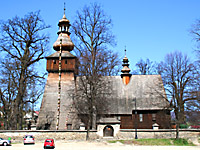
Former Kosciol Sw.
Marii Magdaleny (church of Mary Magdalene) was built of larch wood in
1606. It underwent a reconstruction in the years 1744 to 1778 during which its
impressive tower was added. The church’s baroque decor together with a rococo
altarpiece and choir dates from the second half of the 18th century. Polychrome
wall painting date back to 1802 with older parts of 1628. Surrounding oaks and
limes have been planted in 1637. Since 1936 the old wooden church has been
housing a local museum (Muzeum Regionalne im. Wladyslawa Orkana, 6 Sadecka
street) with one of Poland’s biggest collections of village art.
Period wooden
architecture of Rabka. Besides the 400-year-old larch church Rabka Zdroj
can boasts many timber buildings of the 19th century, usually boarding houses
and sanatoriums. Several of them stand on the edges of the central park popular
with strollers.
One of Rabka Zdroj’s magnets for children is
its Rabkoland amusement park at 2 Podhalanska
street (note: paid parking with a separate entrance is situated on the opposite,
northern side accessible from Rynek square). The funfair operates from May to
October. It contains a routine set of attractions complete with a Ferris wheel
and a small roller-coaster yet many of the merry-go-rounds and other machinery
are old enough to qualify as museum pieces.
The bronze monument to
Santa Claus (Pomnik Swietego Mikolaja) in front of the 19th-century train
station is possibly Santa’s only memorial outside Scandinavia.
An open-air railway
museum (Skansen Taboru Kolejowego) is situated on the southwest outskirts
of Rabka Zdroj, in the village of Chabowka. Its proudest possessions are old
steam locomotives, the most ancient steam engine dating from 1878. The museum
offers short train journeys.
Rabka Zdroj is located at important
crossroads, near international road no. 7 from Krakow to Slovakia’s border
crossing in Chyzne and road 28 from Bielsko-Biala to Nowy Sacz. A railway links
Rabka with Krakow end Zakopane.
Buses to Rabka Zdroj depart from Krakow’s
central depot at 18 Bosacka street (Regionalny Dworzec Autobusowy). Also
independent minibus services are available. Journey by either bus or minibus
takes some ninety minutes barring massive tailbacks.
Several trains a day that leave for Zakopane
from Krakow Glowny central station have a stop in Rabka and the journey lasts
about two hours and half.
Motorist may take several different routes
but most popular (and often congested) is Road 7, a divided highway, via
Myslenice to Skomielna Biala where one should turn left at traffic lights to
Road 28.