|
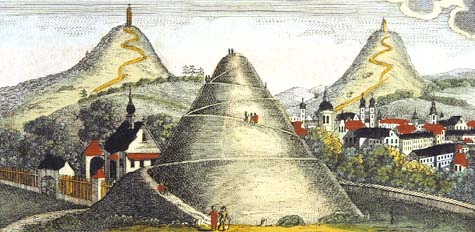
Ancient and historic barrows in Krakow
Krakow’s two prehistoric landmarks, the Mound of Krak (Kopiec
Kraka) and the Mound of Wanda (Kopiec Wandy) have
always mystified historians. Scholars maintain they were
either the 7th-century monumental tombs or fortifications or
pagan temples.
The pair of man-made barrows some fifty feet high (16.7 m
and 14.6 m respectively) upon natural elevations 5,5 miles
apart were easily seen from afar. And together with two
natural Krakow hills they constitute a gigantic astronomical
calendar. From the westernmost Sikornik mountain one can
observe the sunrise exactly over the Wawel Hill on the spring equinox as well as
on the autumnal one, and over the Mound of Krak on November
1, i.e. the Celtic New Year’s Day. While watched from the
Mound of Krak, the sun rises over the Mound of Wanda on the
eve of the second biggest feast of Celts, May 1.
Curiously, in the early 19th
century a monument to Tadeusz Kosciuszko was erected atop
the Sikornik mountain in the form of a 34-meter mound (Kopiec
Kosciuszki). And still further to the west, on the
Sowiniec hill, there is yet another Krakow mound, the
36-meter-high Kopiec Pilsudskiego which dates from
the late 1930s and commemorates Marshal Pilsudski.
|
Krakow
Poland's prime tourist attraction and a must in Central
Europe boasts numerous world-class monuments, charming vistas,
delightful atmosphere, and the best restaurants.
City of Krakow map
Best of Krakow
In the proximity
of Krakow
Krakow is Poland's tourist mecca, and also a gateway to
many other must-see sites in the region.
|